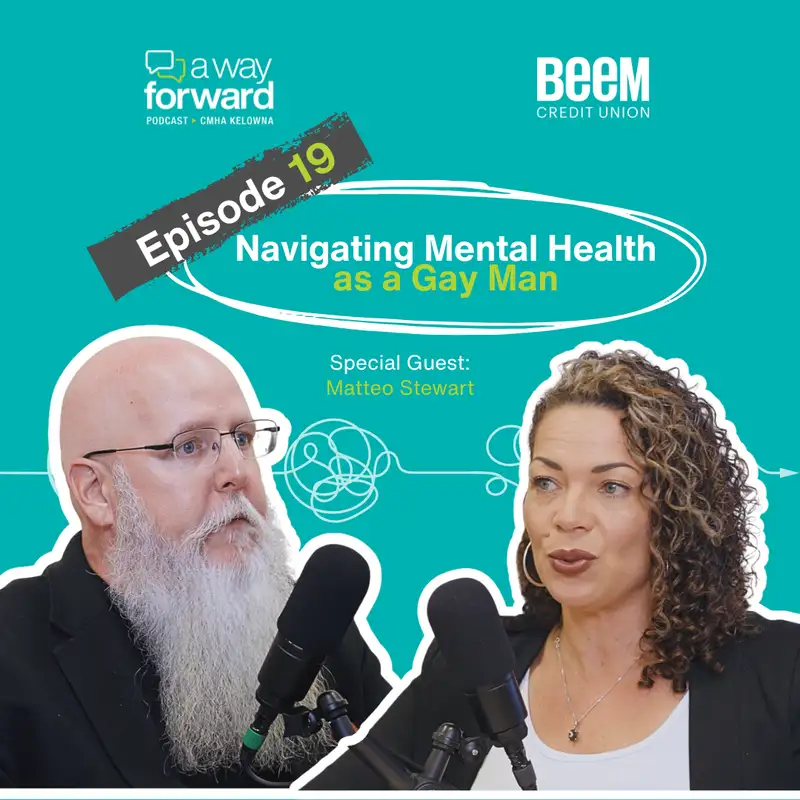
Episode 19: Navigating Mental Health as a Gay Man
Today's topic is men's mental health, specifically gay men and their mental health. My guest is Matteo Stewart. He is a three time international TEDx speaker, a belonging practitioner, and a senior inclusive leadership facilitator, just among a few things. There is so much to unpack in this topic, and it starts at the intersection of mental health and identity. Bean Credit Union is proud to sponsor today's episode.
Jessica Samuels:With deep roots in BC and a commitment to your financial journey, Beam believes wellness, mental and financial starts with support you can count on. Matteo, I am so grateful for you being here. Thank you so much and taking part in this big topic that we're talking about today. You and I sent a few emails back and forth about this, and just to make sure that we had the right focus. And and we talked a lot about identity.
Jessica Samuels:And you said something very specific about identity. And I'm going to read it because I'm going to quote you. And that's where I want to start. In relation to identity, you wrote the different experiences that gay men who are open with their identity versus men who have sex with men but do not openly identify as gay. And that sentence, was like, Yes.
Jessica Samuels:So I need you to speak a bit more about that.
Matteo Stewart:For sure. Yeah. And thank you so much for this opportunity even just to have a conversation, because I'll be very honest. I can't speak from any other lived experience. And when you think about the queer community, the 2SLGBTQIA plus community, I know that's a mouthful, we're really not a community, we're communities.
Matteo Stewart:Right? And there's so many different intersecting identities.
Jessica Samuels:Which is that mouthful of an acronym. But it's also born in your own right.
Matteo Stewart:But I identify as a gay male, and I'm getting a bit older now. I've got some gray in my beard. That said, I have been out since the early nineties, meaning that I've been out to myself, I've been out to my friends and family, I've been out in my career. And from my understanding, you know, when we think about the communities or you think about gay men, especially around health, so many of individuals who might have a different sexual orientation, whether they are open and share that with others or not, is irrelevant when it comes to the end of the day that we're still human beings who experience health challenges, and mental health is important. And the experience that I might have as an openly gay 50 year old here in the Okanagan, very different than somebody who is closeted.
Matteo Stewart:And often those folks are not the ones that get studied academically, are not the ones that get the traditional support, and often get excluded from the support that they probably do need. And that's where my heart breaks. And it really wasn't until and I don't want to but we have all this plethora now of online apps, right, where people who are looking for sex with men can find that. But these are individuals who will not post their picture, these are individuals who will not be out to their wives or to their girlfriends or to the community, and it breaks to hear that these are individuals that, like all of us, you know, are suffering from a variety of different conditions, whether that's mental or physical health, and yet they don't have the same access. Where for me, I think probably because of my, you know, white male privilege of being out, I can go to my doctor and just be like, No, I'm a gay man.
Matteo Stewart:And immediately then we can have a conversation about my health. I've also been diagnosed with leukemia, as well as a tumor that they found in my shoulder, but I can have a very open conversation about my health, about my sexual health, with my health care providers, with my health team. But what about and this is what's really and it's really only within the past couple months that this has come to heart for me is what about those individuals that can't be open because they're not open to themselves or others? How do they access the same health care?
Jessica Samuels:And when you talk about health care, what's unfolded and embedded in that is mental health care. Mental health is health. Okay, so I've been scribbling notes because we basically covered the whole podcast right there, which is great and gives us lots to work off. One of the first things I want to talk about is the first thing you said is out to yourself. As a yeah, as a straight cisgender female, that line out to yourself because and that really talks about identity, because certainly we talk about community and out in the public, a very important part, but out to yourself.
Jessica Samuels:So what is that? What does that mean? What did that mean for you?
Matteo Stewart:For me, well, it was different. Back in the 1990s, I came out in the 1990s, so things were different than they maybe are today. That said, maybe things are changing, right, with the political landscape changing as well. But for me, that meant that I had the fear of I could have been kicked out of the house. I had the fear of, if I left, where would I go?
Matteo Stewart:Who would support me? I didn't have friends that were openly gay when I was 17 or 18. I didn't have that network of support that I have now. So, for me, I have a network of support. So, I'm saying I'm having a bad day, I've got a husband, I've got friends and family, I've got folks that can be there for me.
Matteo Stewart:And that's where I think that, because I'm out to myself, I can be truthful and honest about my lived experiences.
Jessica Samuels:So is not being out in public the same as not being out to yourself?
Matteo Stewart:Well, it's interesting because I love that intersection. And I wonder, and again, I can't speak because I have been out, but I know when I was closeted, the impact that had on me and on my mental health. And if it's okay, I'm going share a story. This hit me just today. I just got from the gym, just before coming here, and this has been something I've been going to the gym as part of my health journey with my cancer treatment.
Matteo Stewart:But at the gym, I've been now accepted by the gym bros. All these straight identifying I don't know, they haven't disclosed but they're very straight identifying, straight acting, if you will. And what I found is the moment they started bringing me into their little group and having conversations, I started lowering my voice. I started I was code switching. And it wasn't something I was thinking at the prefrontal cortex, me thinking about I need to change who I am and adapt.
Matteo Stewart:That was part of my resilience. That was part of my adaptive strategies in order to survive. Even though you were already I've been out since the nineties. And
Jessica Samuels:for intents and purposes of this conversation in this example, you were accepted by these folks at the gym already. You didn't start with code switching. The code switching came after acceptance.
Matteo Stewart:Yeah. And so if I'm code switching, what about others who, because of rhetoric, the political rhetoric out there, I wonder what impact that's having on them and on their mental health?
Jessica Samuels:Yeah. I mean, that's my next question. That erosion, that you know, day in day out erosion of to yourself. So in those quiet moments, when you're with friends or family, or when you're doing something that many people do work out or be active in a number of ways and what and that's that identity piece that we talked about. So you're not being true to who you are, and that takes a toll on your mental health.
Matteo Stewart:It does, yeah. But then so does, you know, me, and I'll be looking at what's happening to our neighbors in the South, the erosion of rights for the LGBTQI plus community, even rhetoric here in Kelowna with local politicians who will advocate for or introduce bills to pull back the rights and freedoms. And we have a neighboring province that is removing rights or looking to use a notwithstanding clause and the impact that has on folks. And it's interesting because I've been spending some time with, because I'm now 50, with a group of 50 plus gay men. We meet every Saturday for coffee, we have different events, we have tea dances, and it's great.
Matteo Stewart:But these are individuals that they came out before I was even born, some of them, and to hear their experiences of what it was like back when to be gay was criminalized. There wasn't the same legal protections. They lived through the AIDS crisis, where they lost so many folks. They don't have that same family experiences. So, yes, they're very resilient, which is awesome, but are they thriving?
Matteo Stewart:It's interesting now when I look at that. Now, when I look at how they are adapting, many of them, some of them, you know, where they've been with their partners for forty plus years, now their partner passes away, and how do they access care services? Or we have one individual who's now gone into a care home who had been out since 1974, but now in 2025 has to go back into the closet in order to survive in a nursing home.
Jessica Samuels:Right. An individual may have thought that they were out, they had community, they had their support network, and that falls apart for whatever reason. And it's almost like starting over. What you're saying is a fundamentally different era, no matter how you look at it. I mean, socioeconomic, political climate notwithstanding, just the fact that we're talking nineties or seventies versus 2025, there is a huge discrepancy in what society
Matteo Stewart:is like. It's so true. And it's interesting because what I'm also discovering, and this is true for myself, is that many gay men, when we came out, that was trauma. And we don't necessarily talk about the intersection of trauma and the gay community, but there's a lot. For many of us, a lot of trauma.
Matteo Stewart:And even though I might think, Oh, I'm fine. I've been out at work. As soon as I hear about some legislation being passed or a bill being introduced, that brings back new trauma. And I get re traumatized.
Jessica Samuels:So how do you manage?
Matteo Stewart:That's just it.
Jessica Samuels:After all these years,
Matteo Stewart:I'm still struggling with that on a personal level. When I heard an antique slur at the gym, which I thought, Oh, here I am being but that's part of what people say, locker room talk. That's still traumatizing. Where this really came to head for me, and I'm going to share the story if that's okay, a few years ago, I was up for election to join BC Hockey's Board of Directors, and to me it was awesome. I played hockey, my grandfather played for Detroit back in the 30s and 40s, and so for me, hockey has been a big part of my family.
Matteo Stewart:We grew up with hockey, and I really wanted I was part of the twenty ten Winter Olympics in Vancouver where hockey, I mean that was one of the biggest highlights for me, biggest highlight of my career was to be able to say that I worked on the Olympics at the hockey venue, you know, when we won gold for the women in the men's. That said, when I was up for election, I was really excited about, you know, and I'd worked on several other boards over the years. But when I went, and it was down in Penticton at one of the convention centers, and I walked into the convention center, I thought I was fine, and I had a bit of a panic attack. Literally, I had to take myself out of the room, went for a walk along the lake, going, Why am I at my age having this panic attack now? And I realized it was bringing up trauma from back in the 80s, when I was gay bashed, in the hockey, at the arena, in the locker room.
Matteo Stewart:Now, if I'm impacted like that, and I'm supposed to be the strong, well adjusted, what about others that aren't? What are we doing to help support them? So it's not just about resilience, but the ability for us as human beings. Because at the end of the day, whether we identify as gay or not, we're still human beings. How do we set the conditions for us to be able to thrive and not just survive?
Jessica Samuels:And part of one of those conditions mentioned earlier was that sense of community. And what's interesting to me is in your storytelling there, and thank you for sharing these stories. When I, I guess when I was thinking about community for this, I was thinking of community of the community in this particular instance would be gay men. But it seems to me like you just talked about you have a community at the gym of straight acting, straight identifying individuals, men included. So is there a distinction between those two senses of community?
Matteo Stewart:I think there is. To be honest, for me, one of the things I love is, now that I've joined this 50 plus gay men's meetup group, is we can just be ourselves. And it's not that we are gay. It just so happens that we're surrounded by other gay men of similar age, similar lived experiences, but we can just be ourselves. And we don't have to be labeled the label is there when we have a tea dance, or we're just meeting up for coffee, or we're going out for a beer.
Matteo Stewart:But we're just us. It's just us, and it's just a group of people with, again, some similar interests, some similar backgrounds, and we can talk about the Blue Jays, or we can talk about hockey, or we can talk about taking care of our garden and getting it winterized. Identity isn't the driving force. Identity is why we're there, but it's not the driving force of the conversation. And so we're building this community.
Matteo Stewart:And so, some of us go to the gym and we work out, and we share workout tips. Others don't even go anywhere near the gym, and that's okay. But we're still together. And for me, it's a very different I can be myself, and my guard is now down. I don't have to think about code switching.
Matteo Stewart:I don't have to worry about anything. And that, to me, is probably the ultimate level of psychological safety
Jessica Samuels:Is that thriving?
Matteo Stewart:For me, that would be thriving, versus I have to be in survival mode, or whether I'm cognizant that I'm in survival mode or not, my body reacts differently. So when we talk about mental and physical, they're interchangeable. They're not two separate things. They're interchangeable. I know when I am thriving, my cortisol levels are lower.
Matteo Stewart:And it's interesting, because of my cancer, I am going constantly for blood work. And what's interesting is when I can see when I am driving, or now that I'm part of this community, my inflammation markers are lower, I'm seeing my blood work is coming back much more positive. When I have stress at work, when I have stress in the community, when I have stress outside, and I don't feel like I have that sense of community, I see my blood work change. And it's interesting to see that. So now I wonder, not everyone has access to get their blood work done every two weeks.
Matteo Stewart:So how do we support those folks that don't even know how to ask? For me, I guess I'm problem aware and solution aware, but so many folks in the gay community, especially for gay men, aren't necessarily problem aware, and not necessarily even solution aware. How do we help them?
Jessica Samuels:Right. Well, and that's part of why we do this podcast, is sharing stories like yourself and talking about things that work for you anecdotally on a day to day basis. We're going go over some resources and things that have worked. But just also trying to build that sense of community that gay male, older gay male, 50 plus gay male community. That's important.
Jessica Samuels:You said we can be ourselves. And I had a question here about societal expectations of men and societal expectations of straight and gay men and how that plays into it. Yeah. I mean, you talked about not to keep bringing it up. You talked about this code switching.
Jessica Samuels:That's also society. I see that as a societal expectation of what a man, full stop, like just man. Man's voice is deeper and his sounds a little like this because this is what you're supposed to do.
Matteo Stewart:How does
Jessica Samuels:that impact your discussions around mental health?
Matteo Stewart:Oh, huge. Because again, I'm not allowed to cry. I'm not allowed to show emotion. When I say not allowed, that's in my head. Why is that in my head?
Matteo Stewart:Because of, again, societal expectations. When I think about when I'm having a hard day at work, who do I get to vent to? Am I allowed to vent? Am I allowed to even talk about it? And that's in my head, but that's where I go, where my expectation is, is that I can't share that struggle.
Matteo Stewart:And what I hear, as now part of this group of older gay men who've come together, we've shared that we have the same concerns of body image, the same concerns now of, Do I fit in? My body is no longer the same as it was back in 1997, when I was at clubs and I was all that.
Jessica Samuels:Aren't we all in that position?
Matteo Stewart:Now, also, where do I find a sense of community? Where do I go to feel like I can just be myself or I can be who I am? The other thing too, which is really interesting, is this notion of when you have a partner I've been together, gosh, don't want to say how many years we've been together. We've married for fourteen years, probably closer to twenty But if I were to, let's say, cancer were to take me, my worry and this is something that my partner shared is, Then what? Then what do we do?
Matteo Stewart:It's not like we go back on the market and we can just easily pick up. It becomes harder to be able to find that sense of community and to be able to talk about things like loss. And loss not just in terms of a death, but loss in terms of one's identity. For me, a big part of my identity is the work that I do. But now, as I enter to the age of retirement, it's like, what is my identity?
Matteo Stewart:What becomes my purpose? I think that's sort of an intersection, too, when you're talking about mental health, is what purpose do we have? Because we know when we look at the data, when people have a purpose, they thrive. Their health improves, both mental and physical. So how do we find that purpose beyond just whatever our identity is?
Matteo Stewart:And for me, I look at, well, yeah, when my career was over, what's my identity? Am I always just a gay man? Or am I a gay man who also plays hockey? A gay man who gardens, also or what else I do. So there's that component as well.
Matteo Stewart:And then for many of us, for me, I'm lucky I have a strong family, but so many gay men, especially gay men who are older than me, are estranged from their family, or their families passed on. So who do they have to go to when they're having a bad day? When they need to get picked up from the hospital because they've just went, you know, like, the other day, they went through radiation treatment. Who's picking me up to drive me home after that? Right?
Matteo Stewart:I have that, you know, community that folks that can come together, but so many people don't.
Jessica Samuels:Are there expectations within, in your experience, within the gay male community, are the expectations about talking about mental health different
Matteo Stewart:Oh, a 100%. Yeah.
Jessica Samuels:In the straight male community?
Matteo Stewart:Yeah. And I can't speak for
Jessica Samuels:all gay men. Of course not.
Matteo Stewart:But for many of us, it's it's it's either you're out and you're strong or you're one of those weak closeted people. And it's an interesting divide that I don't think it's talked a lot about.
Jessica Samuels:You're weak because you're not out.
Matteo Stewart:You're not out. Yeah. You're not out. You're closeted. Those folks tend to get pushed aside in the community.
Matteo Stewart:We don't offer the same empathy or support.
Jessica Samuels:But it's interesting, the other part of that is you said out and strong, that implies We're not.
Matteo Stewart:That's just it. We're not. I'll be the first to admit. Seriously, when they found a tumour, immediately wanted to cry. But in front of my partner, in front of my friends, I put on the strong face.
Matteo Stewart:I didn't cry until I was alone in the bathroom. And that expectation to not be able to address one's feelings or to suppress. Think another thing, too, that's maybe a skill that gay and lesbian people have, is we've done, for many of
Jessica Samuels:us, for
Matteo Stewart:so many years, have been able to either repress our feelings or compartmentalize it so that we can survive. And we're in survival mode all the time.
Jessica Samuels:But we also know you were talking about what's good for our bodies. We know that is also
Matteo Stewart:Because not now you're operating where your amygdala is being triggered, or you're storing unhealthy emotions in the body, are impacting the rest of the whole health system.
Jessica Samuels:Did you have I mean, you talked about specific incidences, and certainly being diagnosed with leukemia is huge throughout your life, instances of struggling to manage your mental health. How did you balance this juggling act?
Matteo Stewart:Here's the thing, and was going to drop it enough, is the only way that I've really gotten over it is to be like, I'm going to struggle and still show up. And for me, that's been my strategy. Now that works for me. That doesn't work for others. And so some people go, Well, aren't you nervous?
Matteo Stewart:And I'm like, Yeah, I'm nervous. I'm scared. I'm sweating like buckets, but I'm going to do it anyway. And that's not always a healthy approach, because I'm not addressing, but it's not necessarily the most effective way of doing it. But that's what has worked for me.
Matteo Stewart:Because that's what I had to do as an 18 year old who's coming to terms with: I wasn't interested in my girlfriend I was interested in her brother. And now what does that mean? And how do I put that feeling aside in the hurt that came from the homophobia, from the comments that would be left on my yearbook, or the comments that would be made in the hallway at high school, or the comments that would be made by the principal or the teachers that were anti gay. And I just survived. I went into survival mode to be able to push that aside.
Jessica Samuels:Right. So if someone who's listening right now in survival mode and you said, I'm going to struggle, but I'm still going to show up, I feel like what I'm hearing is they've to find their way around what that
Matteo Stewart:looks like. It could be. But is that going to work for everybody? No. And I'll be honest, at 50 years old, that has not been the healthiest.
Matteo Stewart:Because guess what that meant? That meant that I, on a Friday night, would be smashing a pizza and a large bag of ketchup or salt and vinegar chips, and I went to food as my solace. And I was very large. At one point, I was over three hundred pounds. And that wasn't a healthy way to deal with it, but that's what I did.
Jessica Samuels:And sometimes when we talk about managing mental health, it's the grief or the struggle being in the moment, noting, acknowledging, but not sitting in that for too long. Yeah. And so that sounds like, you know, kind of oscillate and float in and out of Yeah. We talked about you mentioned accessing health. So whether it's mental health, but in this instance, let's talk about physical health care services across the community as a gay man.
Jessica Samuels:This is another aspect that didn't occur to me because there's also gay men's sexual health. There is a thing and there's actually a resource that we'll mention later on that for that. But then just also accessing health services and the act of sharing with the medical practitioner that you're gay.
Matteo Stewart:Yeah. Well, it's such a critical thing, right? And so if I just take a step back, there's two parts I So want to ten years ago, when I was first diagnosed, it took months for the team to figure out what was wrong. Leukemia can be sometimes difficult to diagnose, but because I shared that I was gay, the initial doctors, because then I didn't have a family doctor, I only had, you know, I'd go to the drop in clinic and be like, Hey, I have night sweats, I am not feeling good, and I mentioned that I was gay, so what did they do? They did HIV tests, they did hepatitis tests, and they kept saying, But you don't have HIV, you don't have hepatitis, you don't have any sector transmitted disease.
Matteo Stewart:Because they were limiting the testing that they did, because the assumption was, because I was a gay man, it must have been HIV, or it must have been a sexually transmitted disease. Not that it could be a disease that affects any human being. And it wasn't until mind you, I was an advocate for myself, and I was strongly advocating that, no, something's not right here, that we finally did some additional tests. But that was months. It was almost like seven months before I got And that, to me, was if I hadn't been that advocate, how long would it been before I started getting treatment?
Jessica Samuels:Well, advocating. Hey, we've talked about on this podcast a lot, you know, advocating for your health and mental health. I mean, it's a tough system out there right now. You know, doctors and nurses and everyone in the medical system, they're working hard. But our system needs an overhaul.
Jessica Samuels:So oftentimes as an individual advocating for your health, it's kind of how we have to roll these days. Has been my experience and experience of many people that I talk to. I again, I didn't think about that about the opposite. So I was thinking about not being out to the doctor. You're talking about being out and making
Matteo Stewart:go the opposite direction. But here's the thing, too, that often doesn't get discussed, especially and again, this is the intersection of mental health and physical health because, again, they're so interconnected is, for many people in the gay community, there are resources like medications like PrEP that could really help help prevent, you know, not just get exposed to HIV or AIDS, but to also be, you know, some preventative medicine. However, here in the Okanagan, if you're in Vancouver, you're in Toronto, you're in Calgary, access to medication like PrEP is very easy to get. Know, you go have a conversation with your doctor, you can get prescribed on it, and you can go. Here in the Okanagan?
Matteo Stewart:Not every doctor will do that. And then if you want, guess where it comes from? It has to be shipped from Vancouver. And not every pharmacy will fill that prescription here because of folks' views on, what they would say, enabling the gay lifestyle, if you will. And so it becomes much harder.
Matteo Stewart:So, if you have a physician that you're not out to, or you have a physician that you do come out to, it's so hard to get a family doctor, how do you then get on PrEP? Or how do you get access to this? Which can be, what the data tells us, in terms of very beneficial for of course, there's all things like safe sex practices, are still very important, still the fact that we have a potential very effective the data is very clear potentially very effective solution, or at least part of a solution. And yet, gay men can't access that equitably here in the Okanagan as compared to other communities in Canada.
Jessica Samuels:So, so that I am clear, You're talking about a widely medically accepted medication. Correct. It's not, you know, it's legal, it's proven and widely practiced in many medical facilities in terms of writing these prescriptions. And you're saying that not only is it not accessible here in Kelowna, we have to you would have to get it from Vancouver. But some doctors and some pharmacies just will refuse.
Matteo Stewart:So in fact, one of the things, one of the groups that I was going to mention, like Kim and Advocacy Canada, will tell you, here's the doctors that we recommend, here's the pharmacies that we'll fill, and that list, when you look at the overall list of pharmacies in the Okanagan, it's quite small. Mind you, there are now online options which you can go to, but then I always wonder, you know, if you're going to an online option, you're not having the same conversation with an online as you would with your primary care physician. And so that's where now I worry about, you know, that intersection of, Does your primary care physician or your care team fully know and understand your entire lived experience and your entire lived history? Because then, now, when you start talking about, Well, I'm having mental health issues, or I might be on other medication, so many folks, because it's not, you know, if I was to be admitted to Interior Health, they would have access to the medications that have been prescribed to me. But if I had to get PrEP outside, guess what?
Matteo Stewart:That's not going to show up when I go to emerge, and I'm unresponsive. And if I can't tell them that I'm on PrEP, they wouldn't have access to that because that's not being administered through that system. And so, we run that risk as well of the medical team, your care team, not having an understanding that gay man's full care that they're receiving.
Jessica Samuels:Right. Yeah. That holistic care. Everything that an individual needs that perhaps individuals like myself wouldn't wouldn't think about that.
Matteo Stewart:Yeah,
Jessica Samuels:right. I wouldn't think about it wouldn't occur to me that a pharmacy would not. Are they allowed to do that? Not fill a prescription. Yeah, yeah.
Jessica Samuels:Gosh, we got so many things to talk about. So much to talk about. I want to how like let's just briefly before we wrap up, you you have a cancer diagnosis. And so really talking about that mind body connection. How are you managing to keep yourself healthy physically and mentally?
Matteo Stewart:So what I'm finding is I'm lifting things. So what I love, folks at Interior Health, great folks that are there, my care team's amazing. But when I leave, I'm on my own. I drive myself home and now how I'm managing is I'm really hyper focused on what I eat. So now, cutting down sugar.
Matteo Stewart:So I'm focused, I've got that laser focus, if you will. But now I'm also moving things. So at the gym, my favorite thing is the sled push and pull. So my trainer's got me, you know, just lifting heavy things. And what I'm finding is when I do that, I've got the headset on, I'm in the zone, As the blood's going, as I'm doing, to me, I'm finding great solace in that.
Matteo Stewart:But then the best solace has been, after I'm done, the conversations that I have. The guys there at the gym, they go, Yo, Jim Santa, you know, I've And got this the lady who works behind the smoothie bar, she's always like, Are you going to get your usual today? And there's just this camaraderie. And then tomorrow morning, so tomorrow, well, wherever the people are watching, but tomorrow for me will be Saturday. At 09:00, I'm going go meet a group sometimes we have 40, older gay men, and I'm usually the youngest one there, so I feel fabulous.
Matteo Stewart:But what I love is we just have conversations, and it's nothing to do with being gay. It's just us just having a coffee together, coming together, and watching folks get their they light up when they see you. And I light up when I see them. To me, that is something that I look forward to. And then we have a gay curling league, or it's a mixed league of gender non specific individuals who identify as part of the community or supporters and allies.
Matteo Stewart:And I don't even curl, to be honest. I have to be careful. So I sit upstairs with a couple of the other folks, and we cheer everybody on. Then everyone, once they're done, comes upstairs and we just have this sense of community. And again, we're not talking about being gay, we're just talking about But it's a safe space for us.
Matteo Stewart:I don't have to worry about somebody making some homophobic comment or a racist comment. We can just sit there, be ourselves, and not have to code switch or mask who we are. We're genuinely excited to see each other. To me, there's no better feeling than that. It's the same when every time I go see my parents, see my mom, know, that big hug.
Matteo Stewart:That kind of community, where everybody gives you a hug, everyone's really excited, and when they ask you, How are you doing? They ask, How are you doing? Right? And that to me, having that And so if we had that more available, or if we had folks where they had a sense of community and a sense of purpose, something to look forward to, Would that help impact folks' mental health? It's not going be the cure all, but could that be?
Matteo Stewart:I'd rather do that than take another I'm done with taking medication now I'd rather focus on healthy eating, healthy living, and stuff that makes a positive impact.
Jessica Samuels:Powerful words. Thank you. And so folks who are listening desperately want that, it's not that they don't believe it's not going to help them. They just don't know how to get started. We talked about resources.
Jessica Samuels:You mentioned check him out or him. Yes, check him out. Ca. PFLAGCanada, GMSH, which is gay men's sexual health. Ca.
Jessica Samuels:What are some other ways that can support holistically and overall gay men that work for you?
Matteo Stewart:One of the things I would recommend is get off the apps. Or you can be on them, but have a group of folks. Have some folks to meet. So for anyone who might be interested, Advocacy Canada, which does a lot of great work to support the 2SLGBTQI plus communities, has some great events for the trans and supporting the trans community. We also have some really great meetups for gay men.
Matteo Stewart:We have a coffee meetup. There's a bunch of tea dances that happen once a month. I love the tea dance because as I'm getting older, I don't want to go to the club anymore. The tea dance is great because it's like, in the afternoon, I'm home by six. And it's great.
Matteo Stewart:And it's over. It's great because then I don't have to worry about going to the club. And then we do, like in the summer, have barbecues where we just come together, and it's just a really great sense of community. And our unifying factor is, yes, we might identify as part of the gay community, but that's only one part of our many intersecting identities. And we can just be our true authentic selves, as we whatever we're going to talk about.
Matteo Stewart:Whether we're talking about football, we're talking about hockey, or we're talking about gardening, it doesn't matter. We can just be ourselves and have that shine in our eyes. And that, to me, is probably the most powerful thing that's really gotten me through the darkest days.
Jessica Samuels:Matteo, thank you so much.
Matteo Stewart:Oh, thank you.
Jessica Samuels:Big discussion. We went over a few resources there. At the end, we'll have the links to those on the A Way Forward podcast page at cmhaclona.org. If you have any questions or comments about this topic or any other topic, please feel free to email me at awayforwardcmhakolana dot org. Until then, please do take good care.
Jessica Samuels:This episode is supported by Beam Credit Union. With deep roots in BC and a commitment to your financial journey, Bean proudly backs mental health conversations that help build stronger, healthier communities.