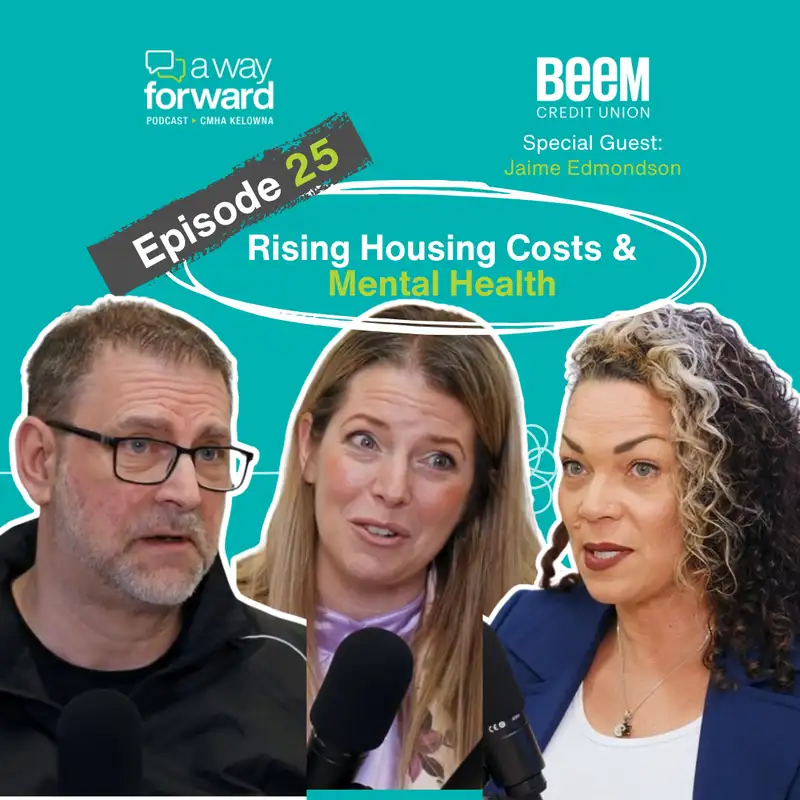
Episode 25: Rising Housing Costs & Mental Health
Hello. I'm Jessica Samuels, and welcome to A Way Forward presented by Beem Credit Union. I'd like to acknowledge this podcast takes place on the ancestral traditional and unceded lands of the Scillic Okanagan people. Rising housing costs and the impact on our mental health. That's what we're talking about today.
Jessica Samuels:CMHA Kelowna CEO, Mike Gullock is here with me and joining us is Jamie Edmonson from Beem Credit Union. We're gonna dig into some of the common stressors and anxieties that come with this topic of rising housing costs and how it impacts our mental health and our inability to take action to get financial help. Beem Credit Union is proud to sponsor today's episode. With deep roots in BC and a commitment to your financial journey, Beem believes wellness, mental and financial starts with support you can count on. I'm glad you both are here to talk about this all too real situation for so many folks out there.
Jessica Samuels:Jamie, let's start with you and your work with Beem. What are you hearing and seeing when people come in and express these stresses and anxieties around rising housing costs? What we're finding is a lot
Jaime Edmondson:of people are feeling quite concerned that they're never gonna get into the housing market. They're already living in rents that are over their means. They're unable to save, and they're almost giving up on the hope of homeownership because homes are expensive, I can't afford to save, I guess I'm doomed to be in this cycle forever.
Jessica Samuels:Right, so it's never going to happen for me. Never going to happen. Right. And then, so we have the renters you talked about, and a lot of renters out there. What are
Jaime Edmondson:you hearing from owners? From home owners, they're really nervous right now about the rising interest rates. They have gone through rates where six years ago, five years ago, rates were at 1.89%. Now we're going to rates about 4%, which is double what they had previously. Now they would make the natural assumption that their payment would double, but their payments not doubling.
Jaime Edmondson:So at least there's a little bit of reprieve there, but they are getting a sticker price on their cash flow, sticker price shock on their cash flow because their rent or the mortgage payments are going up. Well, and I
Jessica Samuels:think about the folks who mortgage payments and then how they have maybe they're renting out a suite in their house. And so that's where you kind of have that crossover of the two groups that you were talking about renters and homeowners not raising the rent too much because they want someone in the spot, but then also to keep up with their rising costs potentially.
Jaime Edmondson:What they're actually finding right now is because of the vacancy rates with the changes with Airbnb's, and then there's more supply now available, they're actually having to lower their rates to actually get renters in there. We're currently around 7% vacancy rate here in Kelowna, which means for every 100 units, seven of them are empty and stay empty over the month. So when you were expecting maybe get 2,200 from your suite and you have to drop it to 1,800, that's a $400 difference in your cash flow, plus now a higher mortgage payment. So it's a double whammy effect too for some of
Jessica Samuels:these homeowners. Right. I'm sure some of the homeowners and renters as well in that position hold their breath every time we talk here, wait to hear about the interest rates. I know I do. I'll speak for myself.
Jessica Samuels:And I'm like, okay, status quo once again, I can deal with I can manage. I can plan around that. Right? Exactly. When I look even for myself over the last, I don't know how many years since they went up and down when I because I track it in my budget, how much it went up and then how much theoretically extra cash I have now because the rates went down, but somehow that extra cash is not there.
Jessica Samuels:And we've talked a little bit about that, about people just being able to maintain and not really get ahead. With all
Jaime Edmondson:the other inflations, you look at gas prices, which jumped up overnight, and you're looking at food costs. I believe food costs went up 35%. So when you start factoring in those, even if your mortgage payment didn't change, you're already behind the eight ball with all the other inflations, let alone a mortgage payment increasing potentially. Property tax too, that goes up every year. Mhmm.
Jessica Samuels:Right. You talked a little bit about a hopelessness off the top. And again, in preparation for this, you you explained to me that in relation to debt or even getting into homeownership, this is where we get the YOLO effect. So talk a little bit about that.
Jaime Edmondson:What you find is if you were to save for a home, it takes the average homeowner seven years to save for that home. If you try for three years, what you're going find is your budget just can't afford for it. The average person needs to save $40,000 for a down payment. If you do that over three years, that's $1,300 a month you need to save every single month. I don't know about you.
Jaime Edmondson:I can't afford to save
Jessica Samuels:50 You're making me anxious just by saying that.
Jaime Edmondson:Okay, so let's bring it. Let's do five years. Let's do five years. Let's not be over ambitious here. Let's go to five.
Jaime Edmondson:But even at five, you're over $700 a month for savings. So these people now have to buckle down, save $700 a month, hope home prices don't increase, thus increasing the amount they have to save. Plus try to pay for car payments, insurance, gas, rent. And if, gosh for it, have to move because of rental eviction or a cell eviction, a lot of people do have to move and now they're paying higher expenses than what they paid previously. Now, if you had debt from a consolidation loan, or you had some emergencies in the past, should you be paying that back first, or should you be saving for a home?
Jaime Edmondson:So it becomes a very vicious cycle to save that $700 And typically after five years, they're still short and takes two more years to save. So seven years to save on a shoestring budget, not living life, not going anywhere, not taking vacations. Most people can't do that. Right. You need to live.
Jessica Samuels:So that's where the YOLO comes in. So I'm going to live. You only live once and this is what they do. And they're making those decisions instead of saving for a home. So less chances that they're going to save a home for a home, or perhaps a different rental market.
Jessica Samuels:Right? Absolutely. I think about young people, and how much are they, how much more are they impacted by all of this? So I
Jaime Edmondson:looked at some stats because I firmly believe that this savings for a down payment is a bit of a poverty tax. And I take a look at young people and I went back to 2019. The average condo in Kelowna in 2019 was $293,000 So to save for a down payment, you need about 16,000. Not bad. That condo now is 450,000.
Jaime Edmondson:So in five years, six years, seven years, guess, sorry, 2019, that appreciation was close to $170,000 plus all that time they would have paid down that home. So they lost opportunity cost trying to save, plus now they have to save even more. So you can see where this hopelessness starts to set in going, I could save, but I've seen historically, it just becomes more and more out of reach every year.
Jessica Samuels:Right, and so why bother? Why, like, it even worth it? What else could I be doing with that money? Absolutely.
Jaime Edmondson:I mean, is it worth it? Home ownership does show that you do have more stability when you do own a home. You get to, if you think about generational wealth, usually comes from having a home, building equity into it, having that stability that you're not going to have to move. You're not going to have to move school districts with your kids in the future because someone sold the home you're living in. Yes, there's emergency repairs, but there's also a sense of pride that it's your home.
Jaime Edmondson:So it is worth it. But when you face that mountain of Everest of savings just to get into the market, it can seem overwhelming. All right, I'm going
Jessica Samuels:to go to Mike here in a moment. But first I want to talk to you about, you and I chatted about kind of the anticipatory shame and guilt when it comes to mortgage renewal. And you talk about that situation, and maybe you have less savings and are more in debt when you go to renew your home than when you first bought it. So there's some situations around that as well. I have friends who know I'm in
Jaime Edmondson:the financial industry, so they'll reach out to me. And they're brilliant people in careers. They just don't understand finance. And they'll come talk to me saying, Hey, we have our kids, we put them into sports. We've got now a line of credit with $15,000 on it.
Jaime Edmondson:We make the payments, but we're worried that we're not going to qualify for renewal. And I have to look at them and say, what do mean qualify for renewal? What are you hearing? What are you worried about? Many people are worried that at renewal, they have to requalify, which they don't need to requalify as long as your payments are up to date, you don't need to requalify.
Jaime Edmondson:But because they don't know that, they're afraid to talk to anybody. They're afraid to talk to an advisor and they're shamed. They think because I have this debt, they're going to think of me differently. So I don't want to talk to my mortgage company because I might get a worse rate or they might not renew me. It is a true fear people have with having debt built up that they're not worthy or they're not as good as they used to be.
Jessica Samuels:Like going to the principal's office and admitting you did something wrong, and that's because you have more debt. You know, you're gonna get reprimanded. Absolutely.
Jaime Edmondson:No one wants to be reprimanded for their debt or have to explain it. And that's where a lot of people rather not talk about it. So they'll maybe sign for a higher rate, or they won't go talk to anyone about how they can improve their financial situation because they don't want to
Jessica Samuels:be judged. Okay, we're going to talk, we're going to come back to that. Mike, you know, listening to Jamie talk, some of these words that are coming up, shame and guilt and stress and anxiety, these are all things that impact our mental health. And we know that the cost of living is significantly impacting the mental health of Canadians right now. Like it's near crisis level.
Mike Gawliuk:Yeah, I mean, certainly the number one stress that people identify and they're experiencing is around money. There's absolutely no doubt about that. And you look at, again, you look at housing costs and you look at food and gas and inflation, you know, it certainly is getting harder to get by and you know home and and a place to call home. We talk about it a lot is like a social determinant of health. You know you need a home to have a level of of of good health.
Mike Gawliuk:And people that are certainly renters, you talk about owners, people that are renters tend to have more increased anxiety than those that own homes. Younger people 100% absolutely are a population that are struggling. I have a 23 years, 23 year old son and the number of conversations that we've had about like how am I going to get into the market? Right? And again, even if he has asset, has a down payment, like how is he going to qualify for a mortgage in terms of the income that he makes?
Mike Gawliuk:Right?
Jaime Edmondson:So,
Mike Gawliuk:so there's all these competing pressures and, and you certainly are right. Like in terms of the vacancy rate in Kelowna, it has gone up. There's been a significant supply of new rental housing that has entered the marketplace. A lot of that is is new builds, right? And so I know you're speaking to people who have secondary suites to help pay the mortgage.
Mike Gawliuk:I'm one of those people. So I know what that experience is like. So yes, the vacancy rate is going up, a lot of these buildings are new buildings. So while we're starting to see rents come down a little bit, it still isn't reaching a place where we have a level of decent affordability across the community.
Jessica Samuels:And I just, there's a juxtaposition there, I guess, not a juxtaposition, but once again, we have the renters and the home homeowners kind of the crossover. And I I recalled something else you said. So, you know, new builds, new home or or new rental market, individuals who so rents are higher. Individuals who are owning homes, sometimes those extra costs, we don't we account for the cost of the house, but then there's and and and that we don't anticipate. And sometimes people get stuck with that, which might then ripple out into the rents for the secondary suites.
Jessica Samuels:Absolutely. So the extra cost people start to realize is, okay, I
Jaime Edmondson:have my house, I pay my property tax, I pay my insurance, we're good. Okay, but don't forget now you have to pay for your water. There's also your electricity and depending how efficient your home is, you might have a much higher bill than others. Other things are the gas, cable, you have to have internet these days. For school, for work, for everything you do, that's quite expensive.
Jaime Edmondson:So you start stacking on all these other costs and they all increase as well. And now you
Jessica Samuels:have an emergency. My hot water tank died. Well, how do you cover that? You didn't have enough money to cover for extra savings on a monthly basis. Now you're putting that on credit, and that starts compounding more of your monthly expenses and your cash flow.
Jessica Samuels:Right. Mike, we were talking about how these stressors could impact an individual's mental health and do impact our mental health. If we just flip that a little bit and understand how individuals with mental health are being impacted by. So you already have a mental health issue and then you have these additional stressors. I could see that talk about compounding.
Jessica Samuels:That would be an instance of that.
Mike Gawliuk:Yeah. I mean, for people that are struggling with mental health or have a mental illness, there are triggers that happen in their lives that cause their mental health to deteriorate. And that is stress, instability. Losing those things tends to exacerbate mental health related issues and makes it worse for individuals, which can result in increased isolation. And it just becomes a bit of a negative reinforcing cycle when people are struggling in that way.
Jessica Samuels:Right. So we always lay the foundation of acknowledging the problem and letting folks know that they're not the only ones, but we always like to kind of talk about, okay, what is a way forward? How do we help manage some of these things? And so back to you, and we talked about, shame and guilt and discussions around housing costs or money. What is your advice in in in regards to financial, what people should do from a financial perspective, and let's get into a little bit about what Beem offers.
Jaime Edmondson:I have even recommended to my most savvy of friends, go talk to an adviser. Do you have a budget? A lot of my friends look at me sheepishly and go, no. I just know there's more month left than money. But if you have a budget, you can start to understand where your cash flow is going.
Jaime Edmondson:And it doesn't necessarily solve it, but it helps you now understand where you can improve or where your stressors are in your life. So that's always what I'm recommending. Talk to your account manager, talk to your financial advisor, because even if you think, I don't have anything to say, what are they going to do for me? But helping to understand, well, you have this car loan, you have this loan, you have these payments. Perhaps there's a way to reduce those payments into a more monthly, a reasonable monthly payment.
Jaime Edmondson:So they're now able to save or at least not go negative every single month. No one's there judging. We truly, truly wanna help people out. But that fear of judgment is usually what holds people back from starting the conversation to say, hey, here's my financial situation. What am I doing?
Jaime Edmondson:How do I do this? What are some of
Jessica Samuels:my tools? It's a lot of similarities associated with mental health counseling, right? Like you have, maybe these tools are buried somewhere, you can't quite see it. So you go to somebody, a professional, who's not going to judge you, and they're going to help you with some of these things and kind of bring the tools into the fore. I always think about, and I did this, I heard this once on a commercial, is how many monthly subscriptions are you paying for that you're not actually using?
Jessica Samuels:And I thought that I was pretty tight in on it, and I found four. And so when you talk about more month than money, that goes into more dollars in your pocket and can help relieve some of that pressure.
Jaime Edmondson:100%.
Jessica Samuels:Talk about, with that, we talk about what we can focus on control for mental health, what we can control. And this is exactly the same thing. Mike, in regards to some of the resources that CMHA Kelowna has around this as well, you've got some programs.
Mike Gawliuk:Yeah, so I mean for individuals, in particular renters who were maybe running into some difficulties, we do have the Central Okanagan Rent Bank that is a program that is designed to prevent eviction, and it provides either one time grants or loans for people that are sort of one step away. Mhmm. It could be a health crisis. It could be a job loss. It could be a relationship breakdown.
Mike Gawliuk:It's smart money to keep people in their homes. We also offer rent supplements for individuals to again, assist them with the high cost of housing. And then partner with different groups like Launch Okanagan, who does financial literacy training and elements like that. One piece that I wanted to add, because, you know, we've talked a lot about homeownership. We've talked a little bit about rental and this notion of affordability.
Mike Gawliuk:And I mean, this is probably a whole other podcast, but I'm going to take it to a place because we're at a really interesting time in our province, in our country. The new stock that's being built, again, isn't necessarily affordable. The province of BC released their budget recently, and in that budget there's a program called the Community Housing Fund. CMHA is currently working on an affordable housing bill that's funded through the Community Housing Fund and the province decided to put the brakes on that And that was $1,400,000,000 in funding and a number of nonprofits from across British Columbia who had invested significant amounts of money, in some cases hundreds of thousands of dollars to apply and had shovel ready projects ready to go. And and they were all paused, and so that's caused for concern when we start to look at again.
Mike Gawliuk:Yes, we've got more supply and yes, that will bring, you know, the housing, some of the rental costs down. But we're also at this point in time and understanding fiscal responsibility and the necessity of that. I fear that we're going to miss out people that are earning lower incomes, can't afford ultimately to live in Kelowna. And then what we'll see is the potential risk of more people being unhoused and or certainly moving out of the community and going somewhere else where it's a little bit cheaper to live.
Jessica Samuels:Yeah. Jamie, comments on that.
Jaime Edmondson:Yeah. I'm so glad you brought that up because I looked at the stats actually just yesterday to verify had it changed recently, and it actually increased in a negative way. So when we talk about affordable housing, it seemed to be 30% of your income or less going towards your housing. Well, the stats show 42% of British Columbians are paying between 3149% of their income for their rent. No, wait, wait.
Jaime Edmondson:Don't take that to mean that 57% are paying 30% or less. That stat was 31 to 49. 25% of British Columbians are paying 50% or more of their income towards housing. And of those 50%, 41 to 49 are paycheck to paycheck, and they're one paycheck away from financial devastation. So this rent bank has come in handy for so many people because your car breaks down, now you can't go to work, you can't pay your rent.
Jaime Edmondson:So at least the ability to have your help with the rent. I've seen so many people through different programs utilize this. It's so important because it's not getting better. It's still getting worse even with the extra supply.
Jessica Samuels:Well, and thank you both for weighing in on this, and it really does. And noting that there's also a portion, a significant portion of the population or circumstances that we were not addressing around this. And, Mike, I just want I wanna go back because I I wouldn't mind to just dive into this point a little bit more. Folks might have an idea about the type of housing that CMHA Kelowna and there's a spectrum of supportive housing. Just so that we can underscore this, you're talking about affordable housing for folks who have lower or fixed income.
Jessica Samuels:This is separate from the supportive housing funnel that you are providing.
Mike Gawliuk:Yes. The build that we're working on is a 49 unit building with studio one, two and three bedroom units. So we're looking to house seniors, families, people with disabilities, really what it's designed for. Ultimately, the need that people have that will reside there is exactly what you talk about. They need an affordable place to live.
Mike Gawliuk:It's like any other apartment building in the community. It simply has rents that are more affordable so that people can get closer to that 30% number.
Jessica Samuels:Okay. Jamie, I'm going to put you under the gun. The final question here. A lot of stats. You said yourself, things aren't getting better.
Jessica Samuels:Things aren't getting worse. What role do financial advisers and folks like Beem play in this, you know, kind of dire situation that we are in and could be in for quite some time?
Jaime Edmondson:So we play a couple different roles. For those who are renting and they need a plan, they want a future, we can work with people. We have a program called the First Home Advantage. So if someone is aspiring for home ownership, we can work with them. We'll actually lend them their down payment so they can focus on actually paying off their debts.
Jaime Edmondson:So when they get into that home, they're set up for success. They're not trying to balance a car payment, a mortgage payment, a student loan payment, we want them to focus on paying off their other debts, so when they get into that home, they have that cash flow and ability to cover the home and weather those different events. For those who maybe home ownership isn't the right time for them, because they're maybe buried under a mountain of debt and they need other help, we're there to help as well. We can help them understand their financial circumstance, see where maybe we can help them out with a lower interest rate loan instead of the payday loans that charge you 60% interest. Maybe there's something we can do to help there to get them out of this cynical cycle of, the vicious cycle of debt and loans and borrowing and debt and loans and borrowing again.
Jaime Edmondson:We want to get them out of that cycle, and we can work with them with their budgeting and different tools to help them. And also partnering with other community partners to help them and referring them for financial literacy training or the rent bank when need be.
Jessica Samuels:Okay, thank you both for that information. Once again, we threw a lot of resources at you, and we're going to have those on the A Way Forward podcast page that's at cmhacolona a colona dot org. And you can always email me at away forward at c m h a colona dot org. In the meantime, please do take good care. Beem Credit Union supports mental health initiatives across British Columbia because caring for each other builds stronger, more connected communities.
Jessica Samuels:United as one, Beem's founding credit unions now serve 190,000 members across BC.