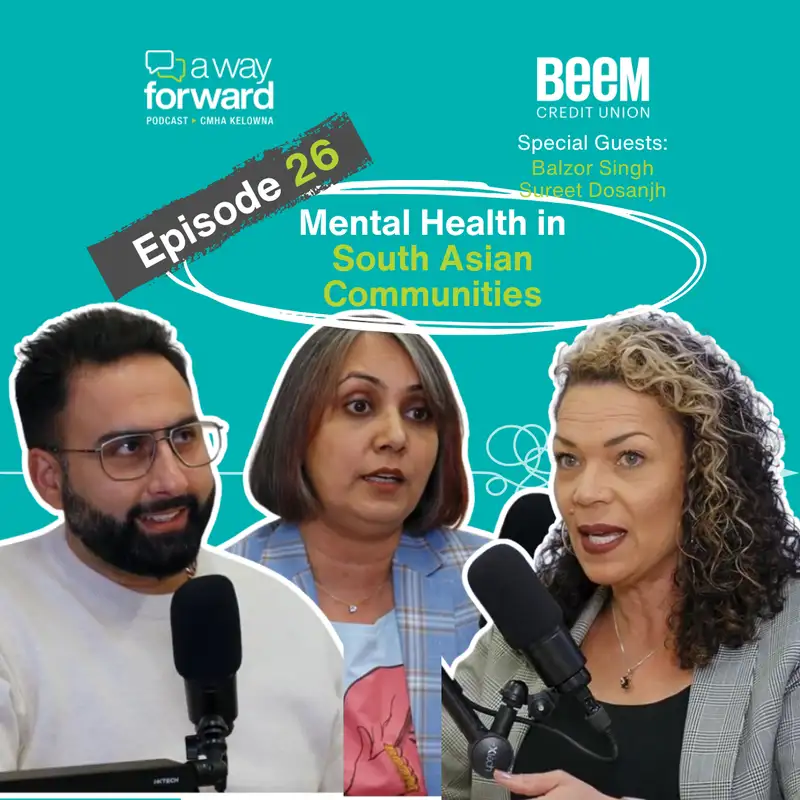
Episode 26: Mental Health in South Asian Communities
Hello, I'm Jessica Samuels, and welcome to A Way Forward presented by Beam Credit Union. I'd like to acknowledge this podcast takes place on the ancestral traditional and unceded land of the Okanagan Silic people. We all know that mental health issues are managed differently by people, depending on who they are, their background, their culture, their community, even their religion. And oftentimes that means that in order to support them, we need to have a different approach and a different understanding. Joining me on the podcast today is Balzar Singh.
Jessica Samuels:He's a community advocate and a businessman here in Kelowna. As well, we have Surit Dosage, who works for CMHA Kelowna. And they're gonna shed some understanding on mental health in South Asian communities. Lean Credit Union is proud to sponsor today's episode. With deep roots in BC and a commitment to your financial journey, Beam believes wellness, mental and financial starts with support you can count on.
Jessica Samuels:Before we get into the supports and the work that you both are doing in the community around this, I want to ask you individually, what was it like talking about mental health or mental health issues prior to this? Like when you were growing up, when we're speaking about South Asian communities? Balzar, why don't you go first?
Balzor Singh:Well, it's one of those things that everybody says, I don't have it. That's a straight answer that you get, even though you see, you probably feel it, but you just hear, Nope, nope, nothing. Anytime you're talking to someone, Hey, do you have I see like you're not stable, like you're not talking nicely or you're getting angry all the time, what's going on? Nothing. So that'll be the answer you get.
Balzor Singh:So that's where it gets tough to deal with a person when you're not know how to reach out to them.
Jessica Samuels:And it sounds like it's a learned behavior because if you're reaching out to them and that's what they're saying, then is there a part of you that's like, Oh, that's the answer I'm supposed to give I'm not supposed to have anything wrong with me.
Balzor Singh:Exactly. I mean, if you're not professional or if you're not trained around this stuff, so obviously you're a reply back, Well, I don't care, If you that's how you want, you don't need my help, so, you know, do whatever you want to do. But then me being now getting involved into mental health and getting professional into it, getting trainings around it, and now I understand it's okay, like it's the conversation that I need to start. That's what I'm looking for. I'm not looking cure or save this person, that'll be the doctor part or later assessment, but at this point, only thing I'm looking forward is a quick conversation that can lead to multiple more conversation, and then we can figure out what's going on.
Jessica Samuels:Right, such a great path. And I want to dig into it a little bit more. Sareet, what about for yourself growing up and prior to you getting involved in this line of work?
Sureet Dosanjh:I think I've been lucky, Jessica, because my parents, my family were really supportive when it came to mental health concerns. They recognized it, they acknowledged it, and my parents always supported me through the rough times. But I always saw in my extended family, friends, or in the community or the society the big words, the ubiquitously used word like stigma, the shame associated with mental health concerns, not acknowledging mental health issues, not normalizing mental health issues was very prevalent. So personally, I have been lucky, I would say. But it was painful to see in the society around me that there was a huge caveat in this regard.
Sureet Dosanjh:Right.
Jessica Samuels:And, Balzar, you experienced that as well. If you don't mind sharing with us a bit of the story about your mom who experienced some mental health issues.
Balzor Singh:So yes, Jessica, I mean, that's where exactly I felt it. I mean, there was that stigma that Sareet said, like, you know, we were always confused in a concept of there's mental illness or there's mental health, but for longest time, all we're thinking is this is sickness, that's it, so that's why people don't want to share it out. They feel like, oh, then I'll be labeled that I'm mentally sick. That's why they're not seeing the consequences, and this is what could, I think, lead for my mom's sickness as well when it happened back in the days. So she was like, keep, you know, taking that inside, I'm okay, I'm a strong woman, I'm working, I'm going out, I have family I have to look after, but then all the problems within the family, somewhat she was probably start blaming herself, maybe I might be the reason I couldn't raise my family this way, certain ways, right?
Balzor Singh:Anything happens within family, I think she was keeping inside, just to feel that I'm strong women, it's okay, it's okay, to one point where I end up leading her mental health, you know, going down, and we never realized lack of sleep, lost appetite, and anything like that until one day she collapsed, right? And then until then I had no idea, like, I'm like, Oh, what happened? And then dealing with her in the hospital, like seeing her where she's not recognizing me was painful. She wasn't eating food, so nurses there, staff there would be like, okay, yeah, maybe you can sit next to her because she's so scared, and then you see all the people around in the same zone, and you're scared too, right, and then that's where I kind of felt like, I'm like, I mean, if we get injured or like an arm get injured, we get even minor paper cut on finger, that hurts, but we never look after our brain, like our brain is the main, you know, component of our body, like our computer, which is running, giving commands, doing things even at the back end, right? But at one point, if that gives, you know, goes out, then you're nobody, like you're wealthy, you're family, you don't run up, you you're nobody pretty much, you're just walking zombie, right?
Balzor Singh:And I've seen it, it scared me. I mean, there was nights like I couldn't sleep because at that point I started blaming myself, I I'm like, Oh, I should have looked after her, right? And then I started blaming all those things, but that's where I kind of hold hand on the mental health side, start following my path. So I got lucky again, I was in Kelowna, end up meeting a few fellows here, and then I'm like, Where do I go? Where do I go?
Balzor Singh:And that's where I end up meeting some of the staff at CMHA, end up meeting Mike, you know, and then I was like, How can I get into it? And he's like, Well, you know what, let me put you through programs, maybe you can do some trainings, get to learn something, you know, later on, I mean, you want to do some degrees diplomas, that's a different thing, but let's just start with how actually you can understand, right? So I did that, it helped me, it helped me because mom was on medication, she came out, two years down the road, she has another collapse, that was like one incident in the family, and then, you know, she took it so seriously, again, same thing, she wasn't sharing with me or anybody around the house thinking, you know what, oh, they'll be mad at me or things like that because of, you know, brain state, she was in mind state, and then what happened, she collapsed again, but this time I was prepared, so I saw very first day, like very, say, first evening as she started walking around, getting nervous, doing dishes over and over, and I'm like, Mom, Mom, what's happening?
Balzor Singh:And she's like, Nothing, nothing, and she's like, This is it. So I called ambulance right away, I'm like, Yes, and they showed up, we took her back to hospital, they had recognized, Yes, this is what it is, and she's like same thing, like she had total breakdown while she was there. She wasn't talking to anybody of us, like not nurses, staff, nobody, all she wanted to just ran out of the premises saying, Leave me alone, to a point where like security called me because, excuse me, it was like during the COVID time, and then security wasn't allowing any family members to go into the hospitals, and especially in the mental health side, like, okay, it's already protected, locked behind the doors, and then they called me, they're like, She's not, she's not allowing to, you know, change it into the hospital clothes, and then she's resisting. I'm like, What do you want me to do? Right?
Balzor Singh:That's why she's there. Like, she doesn't realize who she is and what she's up to, right? So to a point where like I had to transfer her back in, she was in Abbotsford Hospital, so I had to transfer her back here in Kelowna, and then at least I knew until then now how this is working. At somewhat, if my brain was telling me, See, you did wrong again, but at the same time, because of my knowledge into mental health, because of me getting out there learning more and more every day, I was actually training my brain. I knew she's in safe hands now, she's going to come out of it.
Balzor Singh:Yes, it might take month, two months, and then moving forward, we'll watch out for her meds, we'll watch out for everything, but I wasn't blaming myself at that time. So that's one thing I wanted to spread out now, that's why I just took this initiative, especially in South Asian population, where I feel like we see our mothers, we see our aunties around, and I see, I feel them, I see all the older ladies out there, like, you know, struggling with this mental health problem, but they're not sharing with anybody because they feel like either they're gonna put me back, you know, in a room or somewhere because that's how we have seen some of the families back in India, maybe lack of resources, they end up just chaining down people in the houses, Some of the societies, you know, non profitable end up going to their houses, they found out, you know, ten years this person just, you know, tied down with chains, like, you know, next to a wall, and then, you know, no health, nothing at all, no hygiene. So that's where I think a lot of South Asian communities that I feel they have that fear, like if I'm going to share, maybe they're just going to say, Oh, now put this person behind the room and then never talk to this person.
Balzor Singh:So this is where part of like, when I met Sareeth and the other people at Foundry, so we're like, Let's do something about And she was like, Yeah, me being counselor there, I can help you guys, but how do we reach out? So yes, I mean, going back to mom's story, now she's healthy, but she's on meds, proper meds. There's no day like she will go without like sleeping pills or, you know, early morning pills, but at least she's stable health now.
Jessica Samuels:Right. And thank you for telling that story and actually creating a very vivid image about stigma. I mean, you know, I wanted to ask you, and clearly it's clear on how stigma had played a role and and kind of this layer of Sareet, you and I have talked earlier about stigma and then resilience. Like, no. I'm fine.
Jessica Samuels:I've got this. And it's a little bit of stigma, and it's also kind of this idea that resilience oftentimes is framed as a positive thing, but I think there it's a slippery slope. I feel like you've created a vivid image about stigma. So, Sareet, like, from your perspective, like, obviously, stigma is very real and alive and well and plays a huge role in this.
Sureet Dosanjh:Absolutely. Like, I agree with Balzorji that labeling and personalizing mental health concerns is a huge problem. And tied to it is the shame and the guilt that comes with it. Resiliency for once, you know, I feel it's a double edged sword. In our community where group harmony is very important, sometimes well, most of the times, it's even put above individual needs.
Sureet Dosanjh:Resiliency helps when, yes, there is community support, there is family support, there is faith, there is spirituality. Research shows that it has reduced instant impact of stress on people. But when I say it's a double edged sword, sometimes when you have that resiliency in you, whether it's because of the cultural background or whether it's embedded in your system and has that connection with the culture, you suffer in silence. I have seen people suffer in silence and not speak up. They do not choose to recover with support but suffer in silence and almost kind of making themselves believe that I'm fine.
Sureet Dosanjh:I'm strong. And I've seen gender roles come in there as well. Men are supposed to be strong. Boys don't cry. Right?
Sureet Dosanjh:You're the man of the house. You have to be strong. Women, on the other hand, need to imbibe whatever comes their way because they are the primary caretaker of the entire family. They are not supposed to acknowledge they're depressed or anxious because, again, the label comes in that they're going crazy. There's a blurred boundary between realizing understanding that mental health concerns are so real.
Sureet Dosanjh:It's not an illness as such. Having anxiety is human. No one is going crazy or no one is going mad, the labels that are being put, because you are feeling feeling anxious or you you are feeling depressed. You don't feel like getting out of your bed. So there's a blurred understanding of psychiatric illnesses and mental health concerns, which is also a problem
Balzor Singh:Mhmm.
Jessica Samuels:In our community. Right. Balzar, when Sareet said, the expectations of men, you kind of you were like, yep. And you nodded. Seems like you've personally felt those expectations.
Balzor Singh:A 100%. I mean, same thing, like she said, like being a guy, yes, you can cry. And then I have son like who's only like 22. And even if he falls out of like, you know, just like literally couch to a carpet, then it's again, same thing, Oh, nothing's going happen to you, you're a boy. And then I've seen my other friend who happens to have same age daughter, and then if she cries, all family just run there and say, Oh, what happened?
Balzor Singh:What happened? And I'm like, okay, there you go. This is how you're building that no, you're a boy, you're a guy, you need to be hard, tough, and then that what leads to mental health somewhere because now this person wants to cry, but he can't cry. Oftentimes I've gone to some funerals and I'm seeing majority of the guys are standing there, you know, in a funeral house, in home, and then they're just like there, even though inside they're broken because they lost their loved one, but you see women on the other end openly crying, no problem at all, maybe this guy, and I've got to a point where it was so close families, and they said, I just closed the door and I cried because I lost my father, but I couldn't cry in front of public because they're coming for the grief, but at the same time, I need to act tough. I can just hold everyone's hand and start crying there because they'll be like, Are you kidding?
Balzor Singh:Like, you're a guy. Act up. Like, now you need to hold this family. It's on your shoulders. So this is where I started another way of looking around at whoever I'm close friends with, or even some of my clients at my business, I'm like, If you need a friend, go talk, and if you can really trust this friend, if you feel like crying, just cry, and if that cry needs other friend to poke you, just let them poke you, right?
Balzor Singh:And I've tried, and it worked. Like in some cases, like we purposely just say stupid stuff to a friend that we know that they're not going to harm us, and let's poke them and then they start yelling, and next thing you know, that comes out, like with that yelling, the frustration, even though it leads from like, Hey, you didn't do this for me, I have been waiting, waiting, waiting, and you keep poking, keep poking, and next thing you know, they'll spit it out, what else you guys want me to do? I've been doing this, I've been doing, I'm like, exactly, this is what I wanted you to hear, right? And then they started crying, and then they feel like, oh, I'm feeling relieved, and see how helpful that could be, and this is what exactly I'm trying to send out there. Medication, yes, I mean, if you're that at level, but why can't we cure it ahead of time?
Balzor Singh:Yes, if you're at that level where you need anxiety pills, where you need depression pills, sleeping pills, go, go see a doctor, And that's not a shame. That's actually helping you and families around you because you don't know when you're yelling at your six year, 12 year, or 20 year old son or daughter how they feel because you're feeling, Oh, I'm frustrated. Like, These guys don't understand. I work fourteen hours. Same goes for women on the other end too.
Balzor Singh:Like they're working hard, cooking this, that, and if child or husband or mother-in-law or mother, they're not doing the dishes or they're not cleaning and there's mess home, she'll be letting it out, but then if this let out is scream, that's bad, right? And if this let out is crying again all the time, that's also bad, right?
Jessica Samuels:You know, so let's, again, you both have created a good picture of, of kind of the types of things you're dealing with. And the next thing I wanted to ask you about is in the offer of being supports, whether it's formal supports or that community connection supports that you were just talking about, that the importance of cultural competency and awareness and understanding to help navigate some of these complexities. And this is all part of the work you're doing. So let's kind of shift into that. You guys are starting this, or you've been starting this program.
Jessica Samuels:It's a program of supports, but I would like you to chat through the cultural competency piece and how it helps navigate the complexities of the work you're doing. So, Surit, let's start with you. Let's talk exactly what is the program and where are you doing it?
Sureet Dosanjh:Yes, for sure. So this initiative that we have just started is the South Asian outreach program. And as part of which, we are reaching out to the South Asian population because we noticed we didn't have many clients from South Asian background coming into the foundry to seek counseling services. So we figured that let's try and reach out to the people. Let's go to them.
Sureet Dosanjh:So as part of this initiative, we have, as a starting point, started providing free, confidential counseling services. And we are at the Rutland Community Clinic on Tuesdays from 3PM to 7PM. And the good part is that we are providing counseling services in Hindi, Punjabi, Urdu, and English. Thus, it helps to break down the language barriers to a great extent. And on top of that, the counselors we have there, they are from South Asian background.
Sureet Dosanjh:So they understand the cultural nuances and the lived experiences that the people bring in, again, kind of helping us navigate the complexities. People who need services, who want to seek counseling services, they can simply walk in during the working hours. That is three to 7PM on Tuesdays, or they can call the foundry number (236) 420-2803 and just book an appointment, and they'll see a counselor. As part of this initiative, it is also important that we strengthen our community partnerships. So we are working on that too.
Sureet Dosanjh:And we are also working on strengthening our involvement in the South Asian community as well, reaching out to people, making them aware of the services that we are offering. So that's a very big part of our initiative. We have a vision of having a sustainable program that we can expand geographically and demographically, not just reaching out to South Asian population only, but many other collectivist cultures as well, normalizing help seeking, normalizing mental health support as just another part of overall health and just encouraging people to break down those barriers and attain optimal mental health well. Right.
Jessica Samuels:It's just gotten off the ground and getting started. And so when you have individuals like Balzar who are strong community members, strong community advocates on multiple levels and as it pertains to mental health, what role does that competency or cultural understanding piece come? So I guess if I were to simplify the question, how big of a deal is it to have a South there to listen to the problems if you are a South Asian person coming in?
Sureet Dosanjh:I think it's a huge deal because it's one of the major barriers we are seeing in our community. They don't go counselors, even if they're aware counseling services are available, because the one common phrase we come across is they will not understand our culture.
Jessica Samuels:And what and what so, Basar, like, what won't we understand? Like, and I say we, and by the collective me, I mean folks who are not part of the South Asian Community. And I don't wanna I'm not trying to be flippant or oversimplify it. You don't have to list everything. But but, like, what are some things that just would not occur to us or not be we wouldn't be aware of?
Balzor Singh:I think it's just, one thing is language for sure. Mean, if a person speaking Punjabi or Hindi, right, so they're just going to a counselor who happens to have, you know, an English speaking person and then as That's huge. Right? So I mean, even though they probably take, first thing first, I mean, it'll be hard to find an interpreter there who's listening everything and they don't want to share in front of, and if they're taking a friend, that's great because they already shared this stuff and friend is helping, Hey, okay, I'll go with you. And then I already know what's happening.
Balzor Singh:But then they feel like, Oh, friend is already helping me. Then I don't need another counselor now, right? Because my friend is already listening to me. So that's where like it'll be huge success if we end up finding people who can speak the native language the other person speaking, because one thing is now clearly the tone and then the language that they're using. Some of those things, like really, you know, not even like verbs anywhere or words anywhere, right?
Balzor Singh:So it's just a feeling. Hey, I feel low. So I mean, that feel low could be anything in any culture, right? My feeling low in South Asian might be, I'm low in financing, or I'm poor, or I'm dying, or, you know, I am having heart attack, or my feeling low in other culture might be like, Oh, so you're just down, maybe get a coffee, or something like, so could be anything, right? It's just more goes back to like, if that person understand the culture, they could be like, Okay, by the body language, the way, maybe they're not telling what you wanted to hear, and then maybe your question will turn around and then try to lead that person along, and so that it'll be easy for a person to start saying stuff.
Balzor Singh:Maybe otherwise it might be six, seven settings until they come to a point, Yes, I need divorce, right? This is what I wanted to say, right?
Sureet Dosanjh:Basically, I feel that the work we are doing, we are being woodpeckers. Okay. Because breaking, we're not just providing services, we are also trying to break into that rigid mindset where we have to literally act like a woodpecker. We have to keep on going because it is a rigid mindset. And also to add on to the cultural competency part, feel that there's also know, South Asian culture is very complex.
Sureet Dosanjh:Some of the people I've met, they're like I'll give you an example of a friend. I recommended she go to see a counselor. I couldn't see her, of course, conflict of interest. But she was like, the counselor is gonna ask me to establish boundaries with my mother-in-law because they cannot comprehend how my mother-in-law is involved in decision making in my household. But you know how it is.
Sureet Dosanjh:And I'm like, Yes, I know. Living in a joint family is a very normal thing in our community. Family dynamics are part of the mix in a family. The elders making decision for the entire family is very common. So these little pieces, these nuances are what add complexity to understanding the culture.
Sureet Dosanjh:And somebody who has been born and raised in that kind of environment and has also seen what happens around. Like, it's it's not necessarily what goes on in my family. It's the same for Balzorgi's family or another family. We are also very different, though we belong to the same culture. So seeing those differences as well as part of our lived experiences is what also constitutes the cultural competency part, which is tricky.
Jessica Samuels:Yeah. And I imagine there's so many others that you wouldn't even be able to, but that is such a big one because I think interesting you pick mother-in-law for that because I think everyone can relate to mother-in-law. I mean, mine's wonderful. Not saying anything. But thank you so far, so much for this conversation.
Jessica Samuels:I would just want to end, Bowser, with you, you know, talking about just from a community and personal perspective, what has it done for you personally to be involved, not only in the growth that you've done for yourself, with your mother, and also with CMHA Kelowna and for the South Asian Community?
Balzor Singh:Well, I can just say one thing, like, as a human being, now I can die peacefully saying, hey, you know what, I've done something. I always like talk when I have doctor friends, lawyer friends, I'm like, you know what, you all guys have degrees, I'm a mortgage broker, I'm like people think, oh, what have you done? Just maybe two months course and you become, but then you're like, No, as a human, why we're here, right? So we need to find our purpose too. If someone's becoming a lawyer, yes, God given them that mindset, okay, go become a lawyer, it doesn't matter which party they end up choosing, but they're still doing something, that's their job.
Balzor Singh:Doctor, same thing, right? So I'm like, but if you're not in some of those well recognized professions, you're still probably someone who's working at a sawmill or, you know, a cleaner or somebody, but end of the day, you need to find a purpose. Your purpose can't be just like, Oh, I'm just there working, I'm bringing food, family, I'm raising kids, and that's it, that's my purpose. No purpose is to serve, you know, your purpose is to help others. And I'm not saying you are helping thousand and thousand of people, maybe one day, yes, but if you end up helping like five, ten, 20 people that can say, Hey, thank you so much.
Balzor Singh:Just because of you, now I'm realizing that this is how it is, that's what I'm working around.
Jessica Samuels:Incredible. Well, thank you to both of you. Obviously, you're touching many people, and I look forward to hearing this program grow even more. Thanks for being on the podcast.
Balzor Singh:Thank you so much. Thank you.
Jessica Samuels:We shared a few links and resources programs during this conversation. We're going to add them to the A Way Forward podcast page at cmhaclona.org so you can check them out. You can always email me if you have questions about this episode or any other episode at awayforwardcmhaclona dot org. And in the meantime, please and always do take good care. BEAM Credit Union supports mental health initiatives across British Columbia because caring for each other builds stronger, more connected United as one, Beam's founding credit unions now serve 190,000 members across BC.