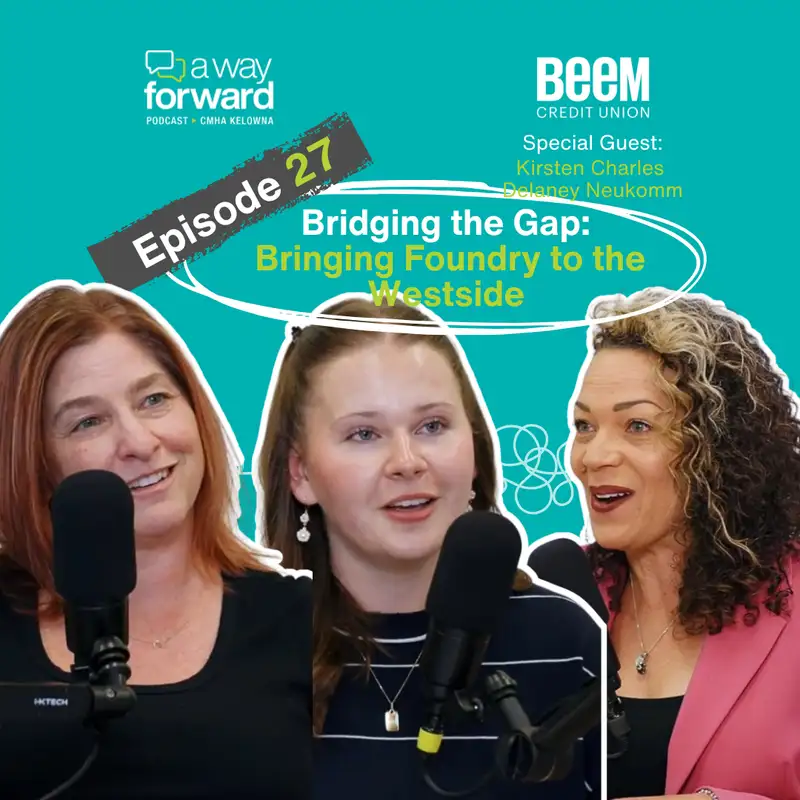
Episode 27: Bridging the Gap: Bringing Foundry to the Westside
Hello, I'm Jessica Samuels, and welcome to A Way Forward presented by Beam Credit Union. I'd like to acknowledge this podcast takes place on the ancestral traditional unceded land of the Okanagan Silic people. Just about ten years ago, Foundry Kelowna opened, and at the time it was a completely unique concept when it comes to supporting and offering resources for youth mental health. Now CMHA Kelowna wants to open a satellite location on the West Side. Delaney Neukomm is a young person who grew up on the West Side.
Jessica Samuels:She joins me here on the podcast, as does Kirsten Charles, who works at Foundry Kelowna. And we're gonna talk about why simplified access to mental health resources is crucial for youth mental health. Bean Credit Union is proud to sponsor today's episode. With deep roots in BC and a commitment to your financial journey, Bean believes wellness, mental and financial starts with support you can count on. CMHA's Kelowna's, not alone bridging the gap campaign is centered around expanding Foundry Kelona's services over to Westside.
Jessica Samuels:And we're going to talk about that satellite, campaign and that satellite youth center in a moment. But first, I think, Kirsten, it's important for us to talk about Foundry Kelowna. We're coming up on ten years. It's hard for me to believe that this has been open. Let's start back from day one.
Jessica Samuels:What does Foundry Kelowna do? Who does it serve? And why is it so important?
Kirsten Charles:Foundry Kelowna works with youth 12 24 and their caregivers. We are looking at providing mental health supports across that age range. You can have a mild mental health issue, you can have a serious mental health issue, you can come and access our services. We are looking at counseling, peer support, family navigation, primary care, along those social service rounds.
Delaney Neukomm:Right.
Jessica Samuels:And so on average, I mean, almost ten years, a lot of stats. How many youth are we seeing coming through the doors and what are you most commonly hearing? What are some of
Kirsten Charles:the things they're coming through for? They're most commonly coming through to access someone who will listen and connect them to other supports. We are looking at a space where youth don't know where to go. And we're hoping that foundry is that first step for them, where we can help them narrow down the supports that they need and provide that for them.
Jessica Samuels:Okay, well, let's skip on over to you, Delaney. I mean, I just wrote that down, someone who will listen, and youth don't know where to go. So this satellite piece is going on West Side. You grew up on the West Side. Those statements, how important would those have been to you coming up, growing up, and even now as a young person?
Delaney Neukomm:I I think they would have been really important. I think the biggest thing biggest thing that you struggle with right now is that sometimes, I mean, everyone goes through high school. It's kind of daunting. It's kind of scary. And I think what's so important about foundries, it kind of gives youth like a getaway in a sense.
Delaney Neukomm:Like, gives you a chance to get To see someone and see a space that's a safe space, that's gonna kind of maybe give up a little bit of distance from, you know, your high school life and what's going on. So I think for me, it would have been really important to kind of know that there's like just this like little bit of a getaway where I can get the support I need and kind of keep it a separate part of my life and know that there's like so much support and so many resources there to support me in that. You know, one of
Jessica Samuels:the favorite pastimes of people who live in this area is to complain about the bridge. And as an adult crossing the bridge in either direction for any reason is kind of like this. And I think about that as an adult, on my best day feeling that way. Now, if I try and put myself in the shoes of a young person who maybe doesn't drive or is a new driver or is coming over to Kelowna for the first time, how much of a barrier in the sea of barriers of accessing mental health can that be for a young person?
Delaney Neukomm:A lot. Even for myself, I live in Rose Valley, and it is the 97 bus that comes from West Kelowna to Kelowna. It would be about a kilometer to two kilometer walk for me because the bus that goes from Rose Valley to one of the bus stations only runs during, like, school hours. So from 6AM to 9AM and then 3PM to about 6PM. So unless I'm trying to go at those hours, then I have to walk to the bus, then get on the 97 and try and get into Kelowna.
Delaney Neukomm:It's quite a quite a trek. So it's kind of almost a deterring factor. Just at that point, I would rather be at home than trying to manage all of the different transportation options to get there, get to Kelowna.
Jessica Samuels:And that that's the reality of young people on Westside right now. So not to say that there's not youth mental health or youth resources in Westside now, but let's talk a
Delaney Neukomm:little bit about, from a youth perspective, that landscape and how will it expand the access to services. I mean, the 97, it's such an important bus and the Exchange, the major stop for it in West Kelowna is about five minutes from the Foundry Westside location. So youth can walk there straight from the bus stop. It's somewhat in between the current high schools and middle schools. So it gives a lot of opportunity for youth to get there and even walking or biking.
Delaney Neukomm:So much, so much easier than trying to get into Kelowna and to deal with whatever transportation they have at hand at the moment.
Jessica Samuels:Right. I know we're focusing a lot on transportation, but it's like, it's a very it's logistics.
Delaney Neukomm:It's a very real thing. It's one element, not to mention all the the mental health and stress and stigma challenges that young people are facing. What about when you were growing up, in terms of your own experience or people that you young people that you knew, what were some of the challenges they were facing to accessing these supports? I think the biggest challenge was just not knowing, not knowing what supports were available and especially not having very many options in West Kelowna. I started the Walk for Mental Health at Mount Bushry and that came from having friends that who needed support and they turned to me or turned to other friends looking for some kind of help and it's, we didn't know what to give.
Delaney Neukomm:So when I started the event, it was truly because I was looking for mental health supports and I came across Boundaries website and I was shocked to never have even heard the name before at any point in my life. It's just, it's such a barrier when you don't even know what there is to support you.
Jessica Samuels:And talking about that personal experience and the walk for mental health done through Mount Boucherie, which is still going, by the It's way, going an incredible fundraiser. So thank you for starting that. But how, that's one way your experience is impacted. But what about the impact your work now? Because you're here with CMHA Kelowna supporting this initiative.
Delaney Neukomm:Yeah, I think I just realized how much I want youth to know what kind of help there is for them. And really driven me to continue the event, the Walk for Mental Health brand for three years under my leadership. And then it's pushed me into my hopeful future career too, because I just really want people to know that there's support out there for them and that there's always gonna be that, whether or not it's, we're building new support or we're maintaining what's currently being run, needs to be done.
Jessica Samuels:Okay. So back to the, I'm on the logistics focus, Kirsten. So we talked about accessing for youth, but we're talking about a satellite spot. So a satellite center of Foundry Kelowna on the West Side. Let's get into the details of what you hope to accomplish with this.
Jessica Samuels:What kind of services, how many youth will be able to access this?
Kirsten Charles:We hope to continue already what we're doing on a smaller scale. We are still going to offer walking counseling, peer support, family services, youth education and employment, and connection to primary care as needed. It will be on a smaller scale, of course, but we want it five days a week to be able to access youth to access. And I look at the numbers of youth that have accessed, the West Side that have accessed Foundry Kelowna over the last nine years, and that number is almost at 1,200. So here we are at 1,200 youth on the West Side that no longer have to come across the bridge and can access in their own community.
Jessica Samuels:Right. And that's just a number by what you're going from here. It could be more because those are the ones that have been able to access. And isn't this really about simplifying access, like just making it easier. I'm not going to say it's easy, because asking for help is not easy, but making it easy.
Jessica Samuels:How did you decide, or how will you decide? Because it's still early days, so I don't want to pin you down too much. But how will you decide? How will that roll out, like in terms of community engagement, in terms of service provision? What was kind of that process?
Jessica Samuels:And I think you both probably have an answer for that. Hear me. Yeah. I think the biggest
Delaney Neukomm:thing is talking with youth and the families and their Like we need to hear what other people, who the people that are going to be accessing our services need and what they want in our community. That's the biggest focus. I think really making sure that youth are able to find a space that works for them. So being out in the community, Walk for Mental Health is gonna be kind of a great place for us to start. We can start making that conversation and having that with the students at Mount Bushry and just making sure that we focus on what needs are needed and what are being hopefully will be met at that point.
Jessica Samuels:Right. I don't want to cast too dark of a shadow on this, but we know we're in a world where resources around healthcare and mental healthcare are not in large supply. So what are some strategies, whether it's with community partners or ways that you guys intend on approaching this in order to not only provide, but maintain these services?
Kirsten Charles:Our intention is to engage with our community with engagement teams. We are looking for youth engagement teams as well as caregiver engagement teams and then already sitting on part of a Westside action table to identify the needs in the community and how we work better together.
Jessica Samuels:Okay. Okay. Sounds good. Good answer. Nice one.
Jessica Samuels:And I guess the other question that people will want to know is when can we expect Foundry Westside to open? Again, I know it's early days. We're here, we're talking about it. You know, we're going to share a little bit about the fundraising campaign here. I will in a little bit.
Jessica Samuels:But when can can these youth, and caregivers and community supporters expect to be able to
Kirsten Charles:access this resource? It is ultimately too soon to tell. We do want to keep the community engaged in celebrating our milestones as we touch them and hit them. So following us on social media is going to be a big piece as we intend to inform the community of the steps along the way. But in terms of a timeline, it's difficult.
Kirsten Charles:We want to do it well. We want to build it well. We want to build it successfully and meet the needs of our community. And we need that community engagement to do that. Right.
Jessica Samuels:And yeah, do it right, not necessarily quickly. Knowing there is a need. Just as we wrap up here, imagine that we are nine years down the road with Foundry Westside. Delaney, let's start with you. What will you hope to see have been accomplished by this satellite center?
Delaney Neukomm:I think my biggest thing that I would want to see is that youth just know Foundry's name. I think that's one of my favorite things about the Walk for Mental Health is that there became like this recognition of this service and there became this connection that wasn't there before. So just having this like rooted community that we know that there's support available would be my biggest achievement for Foundry Westside.
Kirsten Charles:Okay, Kirsten, for yourself? I echo that. I want youth to know, I want youth to know their support, their support for any thing they want to talk about, for connections that they want to make. I want them to know.
Jessica Samuels:Right. Know and be heard, like you mentioned earlier. Thank you both for your time today. Bridging the Gap fundraising campaign is underway. You can find out more about it at cmhacolona.org.
Jessica Samuels:Also, they're looking for Friends of Foundry, and this is sort of a champions table. They mentioned it here earlier about engagement teens, advocates in the community who can share the word about Foundry Westside and Foundry Kelowna and how important it is for youth and caregivers mental health. So if you have any questions about this, you can always check out the AwayForward podcast page at cmhacolona.org, or you can email me at awayforwardcmhacolona dot org. And as always, please do take good care. Beam Credit Union supports mental health initiatives across British Columbia because caring for each other builds stronger, more connected communities.
Jessica Samuels:United as one, Beam's founding credit unions now serve 190,000 members across BC.