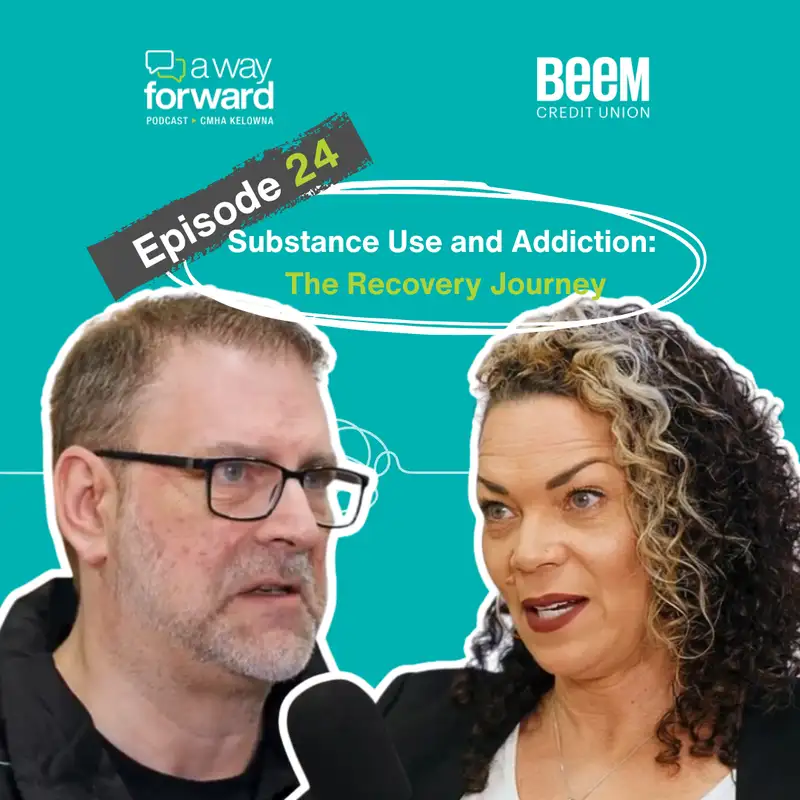
Episode 24: Substance Use and Addiction: The Recovery Journey
In this episode of A Way Forward, host Jessica Samuels sits down with CMHA Kelowna CEO Mike Gawliuk to unpack one of the most misunderstood topics in mental health: substance use and addiction.
This conversation goes beyond surface-level assumptions to explore what addiction really looks like, why recovery takes time, and what supports are needed to help people move forward.
Key Takeaways
1. Addiction is a chronic, recurring condition
Recovery is not a one-time fix. Relapse can be part of the process, not a failure.
2. Detox is only the beginning
Detox removes substances from the body, but it does not address the underlying causes of addiction.
3. Treatment is a process, not a place
Recovery can take many forms, including outpatient care, day programs, or residential treatment. What works varies by person.
4. Addiction is often rooted in pain
Substance use is frequently a way of coping with trauma or unresolved emotional challenges.
5. There is no “one-size-fits-all” recovery
For some, recovery means abstinence. For others, it may involve reduced use, stronger coping skills, or rebuilding stability in life.
The Four Pillars of Substance Use Response
Mike highlights a widely recognized framework for addressing substance use:
· Prevention – Early intervention and education, especially for youth
· Harm Reduction – Keeping people safe and alive while building connection
· Treatment – Access to care across a continuum of needs
· Enforcement – Addressing supply and public safety concerns
Each plays a role. None works in isolation.
System Gaps Identified
· Lack of seamless transitions between detox, treatment, and recovery
· Limited access to supportive, recovery-focused housing
· Insufficient early prevention and intervention funding
· Fragmented care systems that make continuity difficult
A key insight: Where someone goes after treatment can determine their long-term outcome.
Shifting the Mindset
· Recovery is not a “movie of the week” transformation
· Progress may take multiple attempts
· Compassion and understanding are essential, even amid public frustration
· Addressing behaviour does not mean ignoring the underlying causes
What Does Success Look Like?
Success in recovery is not uniform. It may include:
· Long-term abstinence
· Reduced substance use
· Improved mental health and coping
· Reconnection with work, family, or community
· Ongoing support through programs or peer networks
The path is different for everyone—but support is critical at every stage.
Final Thought and Resources
Addiction is complex. Recovery takes time. And meaningful change requires a full system of support—from prevention to housing to long-term care.
- For supports, visit www.cmhakelow.org and click on programs & supports
- Crisis Response, Community Led (CRCL): you can call or text the CRCL team at 778-940-2560
https://www.interiorhealth.ca/locations/kelowna-mental-health-substance-use
- For supports, visit www.cmhakelow.org and click on programs & supports
- Crisis Response, Community Led (CRCL): you can call or text the CRCL team at 778-940-2560
https://www.interiorhealth.ca/locations/kelowna-mental-health-substance-use
https://www.camh.ca/en/health-info/mental-illness-and-addiction-index/addiction
Regarding Youth Substance Use
Regarding Youth Substance Use
https://foundrybc.ca/research/mental-health-and-substance-use/
https://www.cbc.ca/listen/live-radio/1-110-daybreak-south/clip/16208916-an-overdose-crisis-decade-on.-well-reconnect-one
https://www.cbc.ca/listen/live-radio/1-110-daybreak-south/clip/16208916-an-overdose-crisis-decade-on.-well-reconnect-one
More information and links can be found on the A Way Forward Podcast page at cmhakelowna.org.
Have questions or suggestions? Email us at awayforward@cmhakelowna.org
About the Podcast
A Way Forward: Conversations on Mental Health is presented by Beem Credit Union, supporting conversations that help build stronger, more connected communities across British Columbia.