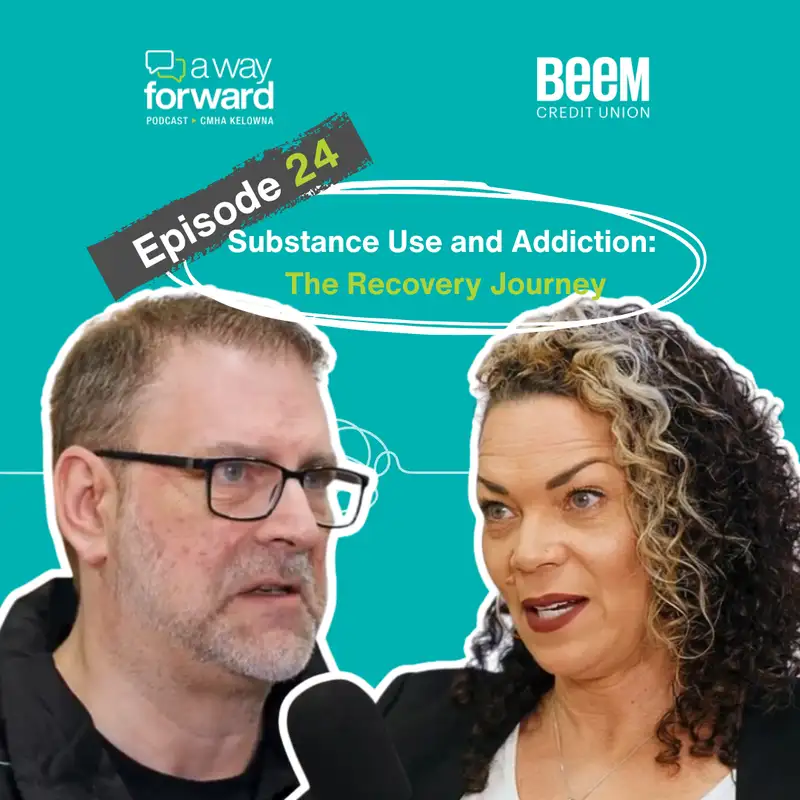
Episode 24: Substance Use and Addiction: The Recovery Journey
Hello. I'm Jessica Samuels, and welcome to A Way Forward presented by Beam Credit Union. I'd like to acknowledge this podcast takes place on the ancestral, traditional, and unceded lands of the Syilac Okanagan people. CMHA Clonus CEO Mike Golic joins me today, and we're talking about substance use and addiction. We're also talking about recovery and treatment and how this process can take a while, sometimes a really long time.
Jessica Samuels:We'll also discuss how the process can be as diverse as the people who are trying to overcome it. Beam Credit Union is proud to sponsor today's episode. With deep roots in BC and a commitment to your financial journey, Beam believes wellness, mental and financial starts with support you can count. Mike, I'm so glad to have you on to talk about this topic in particular because as I was preparing, I emailed you and I said, okay, what are we gonna talk about here? We're gonna talk about, substance use and addiction.
Jessica Samuels:And I threw a couple of ideas your way, and you sent back like a a thing, but was really which was really good. But what's really interesting to me is it focused on, it seemed to me, explaining addiction, explaining treatment, explaining recovery from the very beginning understanding of it. And it's so interesting to me because you have been in this sector sector for so long, and you still feel there's a need for us to start at the beginning to explain to folks what addiction is really like for the person.
Mike Gawliuk:Yeah. And that must have been some week if that email response was
Jessica Samuels:the I felt like it.
Mike Gawliuk:Yeah. Think, I mean, the reality is, of course, we look at the past number of years, we 've got the drug poisoning crisis. We've got experiences of increased numbers of people who are unhoused, most recently in Kelowna, some of the chaos that's taking place downtown and activities that need to be addressed. I think oftentimes it's a scenario whereby it can be really, really frustrating and people are looking for an answer. Right?
Mike Gawliuk:People
Jessica Samuels:The are looking individual experiencing this or outside the folks?
Mike Gawliuk:I would say both. Yeah. Yeah. Yeah. Sometimes it's the individual.
Mike Gawliuk:Sometimes it's society that's looking for the thing that's going to change this. And in my experience, and certainly what I know is we hear a lot about this notion of treatment. And I think, again, for people that maybe aren't necessarily close to the issue or have an experience to that, I think sometimes there's this sense that, and we hear oftentimes, we need more treatment beds. There's a certain truth to that, but I think there's also a certain understanding that's necessary when it comes to substance misuse in the sense that it may be that there are people that believe that, you know, once somebody's gone off to treatment, you know, things are better. You know, it could be the TV movie of the week, and you go to this place, something magical happens, you focus on addressing your issues, and then you come out and you're fixed.
Mike Gawliuk:And the reality is that that's not necessarily how things work. Substance misuse is a chronic recurring condition, right? And so relapse is part of that. And so when people talk about going to treatments or people talk about going to detox, that can really be just the beginning of someone's recovery journey. Like going to detox, simply what that accomplishes is it gets the drugs that you're using out of your system.
Mike Gawliuk:It doesn't do anything else. And it needs to be addressed carefully because, again, when we're talking about opioids and what we know about opioids is that if someone goes in and goes cold turkey and they have a ninety eight percent chance of a relapse. And what we know is if they go in and they no longer have a tolerance built up, and we know the likelihood is that they're going to relapse in a way, we're kind of loading the gun. Now fortunately, medication, opioid agonist therapies that are prescribed for people in order to manage and address those issues so that when someone leaves, they're not necessarily going to have that experience. But that's all detox is.
Mike Gawliuk:That's all detox does. And then from there, someone may enter into a treatment program. Now that assumes that there's a system of care where there's a seamless, you know, from detox to treatment, which isn't necessarily always the case. There's work being done in British Columbia, certainly in Vancouver and out of St. Paul's Hospital called the Road to Recovery, which is really trying to build out a continuum around substance use care.
Mike Gawliuk:And really, it's a matter of ready access, the ability to pass the baton when that person is ready to move to the next stage. And that's encouraging. It's definitely showing benefits. But to get back someone entering treatment, depending on how long it is, it could be thirty days, sixty days, a little bit longer. People are just starting to learn what it's like to live without that drug in their system.
Mike Gawliuk:Right. And, you know, there's a saying, you could ask why the addiction? What you should really be asking is why the pain? Because in many cases, people that struggle with substance misuse are really trying to medicate pain, whether that's early childhood trauma or other factors in their lives. It's really trying to cope with, you know, significant issues.
Mike Gawliuk:And so now when you take that thing that you used to try and cope out of your world, you have to learn to live without that. And so treatment and that's the other part. We'll talk about what treatment looks like because there's various forms of that is really an opportunity for people to start to learn how to live without that substance ultimately. And treatment isn't necessarily a place. Treatment is a process.
Mike Gawliuk:And so there's various forms of treatment. Treatment can take place on an outpatient basis. So depending on the severity of someone's situation, it might be that they're seeing a counselor regularly to address their substance misuse. In some cases, there's more intensive outpatient programs. So for example, at Foundry, at our youth clinic, we have a day treatment program and young people come there, you know, like four days a week for full days.
Mike Gawliuk:And it's an intensive program where they're working to, again, learn how to manage, learn how to cope and address some of those issues surrounding the substance use. So it can take place on an outpatient basis. And then yes, there's treatment beds and there are inpatient services that are available and are necessary. And in part, it depends on the individual, where they're at, and ultimately what their life is looking like as to what treatment option might be most effective for them.
Jessica Samuels:You mentioned earlier that you were using the example of talking about detox and opioids, and certainly that is a significant substance that's impacting so many folks right now. Would you say the same is true? And I just want to kind of bring this point home for the listeners. There's also addiction. There's all types of addiction.
Jessica Samuels:So in that example about detox and treatment and chronic and relapse, we're talking about alcohol, all kinds of drugs. So you're not specifically just meaning opioid use.
Mike Gawliuk:No, certainly any substance from alcohol to different drugs that people are using, talking really across the board.
Jessica Samuels:Right. And so you mentioned this continuum and the different types of treatment. So we know there's a spectrum of treatment and the spectrum of continuum. Talk a little bit more about what needs to be there for the person in that piece that you said there about chronic, because I don't know that folks who have maybe not experienced this through themselves or with a loved one realize that it's not a movie of the week or not to be too trite about it, but they're not going to go away for twenty one days and come back and everything's going to be fine. Or they, I mean, they might.
Jessica Samuels:I don't want to negate that that doesn't happen.
Mike Gawliuk:Yeah. I mean, I'm sure there's circumstances that take place where people do take that step forward and then, you know, follow-up and find their recovery journey and ultimately what works for them. But knowing that it's, again, you know, a chronic relapsing condition, you can expect along the way that that relapse is going to happen. And now when it does, and again, if you look at someone who's, you know, engaged in treatment, they talk about like having a slip. And so relapse can be an opportunity to identify what took place, what were the triggers, what caused that relapse to happen, and then work with your supports to plan for preventing that in the future.
Mike Gawliuk:In some cases, relapse can result in someone falling back into ongoing substance misuse and then potentially looking to do it and have to start the process all over again. I mean, certainly I've heard stats. I don't know the recent stats, but in some cases it's been uncited that for some people it takes up to seven tries to get into recovery and continue to focus there. I mean, in the old days it would be they're getting clean or this notion of abstinence. You know, so that's significant.
Mike Gawliuk:And again, I think people need to realize that it is a process. Relapse is part of it. And ultimately, it isn't necessarily something that is going to be a one and done and everything's better. Because when you think about for a lot of people that struggle with substance misuse, There's that pain that you're trying to, know, you're just trying to manage. And then when you think about it, and I think, you know, try to put yourself in the shoes of someone that's struggling.
Mike Gawliuk:And again, I'll go a little bit to the notion of people who are unhoused. There's a lot of shame that comes with that as well that people feel and that they experience while they're using substances. And there are things that they may do and behaviours that they may engage in that they wouldn't necessarily have done so and may not once they're in recovery. But that's how substance misuse works. I think what I can say is, again, this is a struggle that we see in our province, is that because it's become more visible, because of these struggles, I also think that there's a real sense of, I wouldn't even call it compassion fatigue, I would just say people are fed up.
Mike Gawliuk:Right? They just want whatever this is to end and are looking for that magic wand or that, you know, screwdriver or that hammer that's gonna fix the situation. And the reality is that the tools that are required are all of those and and more.
Jessica Samuels:Well, I was going to ask you as a service provider, what are the gaps in the system that you see that that need to be there? And it's not meant to lay blame, but if we want to, have higher success rates and and support, we're actually going to talk about that, what success looks like, but higher support rates. What do we need to be doing more of?
Mike Gawliuk:Well, I'm going to go back to, I mean, this, I don't know how many years ago it was now. I believe it was Philip Owen when he was the mayor of Vancouver, and they launched the four pillars approach around substance misuse. And, you know, I think the four pillars are as relevant now, if not more relevant now, than they were then. So when it comes to substance misuse, really, that's made up of prevention, right? And so that can involve working with young people.
Mike Gawliuk:There's a program that Foundry British Columbia is currently launching called Preventure. That is a program that's offered in schools and is working with young people around the prevention of substance use. The days of the DARE program and the Just Say No stuff, that kind of thing, science has shown that that really wasn't effective in terms of deterring substance use. We've talked about on this podcast many times about the need for prevention and early intervention. And it's, of course, often one of the ones that's least funded, but absolutely necessary.
Mike Gawliuk:Another pillar, and the one that's been fairly significantly identified over the course of the last several years, is harm reduction. And really harm reduction, a very controversial subject. And the reality behind harm reduction, and I think some of the maybe clarity that needs to be seen is that if you look at harm reduction over here and you look at recovery over here, they're not diametrically opposed things. Harm reduction ultimate, the idea behind it prior to the opioid and drug poisoning crisis was around reducing the spread of blood borne pathogens. And then it became about saving people's lives.
Mike Gawliuk:And so of course, we've been in this ongoing crisis now for a number of years and harm reduction has been a significant part of that approach. Again, super controversial. There's various camps. It's definitely an eitheror. You look at just recently in Ontario, where a number of overdose prevention sites were cut by the government those resources diverted into treatment.
Mike Gawliuk:I first learned about harm reduction from this awesome street nurse, Kathy Turner was her name, thirty years ago when I first started in the field. And what I learned about that was that harm reduction, again, is designed to keep the person alive. And ultimately, through that, the ability to build rapport, build relationship, build connection with someone who might come into an OPS site is important. It's not simply a transactional process. It needs to be a relational process.
Mike Gawliuk:And when it is, harm reduction can actually be the pathway to recovery. That being said, everything that's associated with that is absolutely what makes it controversial. There's no doubt about that and the impact that it can have on the communities. But it's been a fairly prevalent approach over the last few years because of the drug poisoning crisis. Third pillar is treatment.
Mike Gawliuk:And again, we touched a little bit on the types of treatment. Certainly, again, when someone comes out of treatment, there are recovery opportunities through different organizations where people can live in a supportive environment for an extended period of time, which are substance free and allow people to again move towards recovery. You know, the pendulum certainly and the focus now is around treatment. And it is absolutely necessary to have treatment resources available And community based mental health and substance use resources are important as well, because it's not always that you need the most expensive bed there for people. But there's no doubt that treatment is necessary.
Mike Gawliuk:And there's no doubt that there's a gap when you look the progression. I think the other gap that exists is, and we see this and we experience this on a fairly regular basis, is that when somebody is maybe leaving a supportive recovery home or they're leaving a treatment facility, where they're going is super important. And for those people who've maybe, you know, been unhoused, maybe they've been living in a harm reduction environment, going back to the situation that they may have come from is not necessarily going to be really a good part of their recovery plan. And so what I would say a significant gap within the system is, and we, you know, we talk about supportive housing and supportive housing's super controversial in this community and again, across this province. And I would say what we need is need supportive housing that is also recovery based and recovery focused.
Mike Gawliuk:At this point in the province, supportive housing through BC Housing, ultimately there's a requirement to be harm reduction focused. And we're starting to see dribs and drabs here and there where there's a focus more around some recovery based supportive housing and some examples of good work that's being done. And so where there's a gap is, again, people are coming out of, whether it's supportive recovery or whatever that looks like, it's where are they going to go. They have to have a safe, supportive place to land. And I mean, if that's home, then that's great.
Mike Gawliuk:But if don't if there isn't a home and you're going back to the circumstances from which you came, again, we unfortunately tend to go and perpetuate this cycle. And so treatment is absolutely a piece of the puzzle. In British Columbia, of course, the discussion around treatment now tends to be a little bit more around whatever it's framed up as. We did a session on it, involuntary care or compassionate treatments again. And again, there's a small percentage of people that need that high intensity service.
Mike Gawliuk:At the end of the day, what we need is we need resources for people when they're leaving and they're discharging from whatever setting it is to be able to go to and have, know, again, a safe and supportive place that's going to support the recovery. The fourth pillar, last but not least, is enforcement. And certainly another controversial aspect of the whole piece in our province is the, you know, the decriminalization experiment that, you know, obviously has now ended. And I mean, enforcement in the context of substance misuse and those elements certainly on the one hand is focused on and probably needs to be focused on, those groups that are supplying the drugs into our communities, that kind of thing. So organized crime and otherwise.
Mike Gawliuk:Before decriminalization, it's not like if someone had a small amount of drugs on them, they were necessarily getting confiscated or, you know, arrested or anything like that. I think what, you know, decriminalization did, of course, is that, again, created an environment where people were actively using substances. It became more visible. Cities had to put rules in place around no gos and those kinds of things, that kind of thing. Finally, it you know, decriminalization was ended.
Mike Gawliuk:I do think there's a role for enforcement too, of course, when we look at some of the public safety related and disorder that we see in our communities. I think when that's the result of untreated substance misuse, maybe concurrent mental health disorder, and obviously we're hearing more about acquired brain injury, that enforcement, you know, ideally would be able to help support people move into a recovery setting, you know, lock them up and throw away the keys. Because I think, you know, I think people will People are going to disagree on a lot of things, but I think everybody wants to see change. I just think that and in my experience, and I know that there is very strong and in some cases diametrically opposed camps that believe what is the most effective. And that is one of the challenges.
Mike Gawliuk:Now, will say, you know, for the downtown business owners, we've experienced this here at our office as well. You know, I know people who are extremely compassionate people who are also small business owners and, you know, have businesses and have businesses downtown. And when they have their vehicles broken into or their windows smashed or those kinds of things, like, absolutely, that's that's going to anger them. And absolutely, the behaviour that comes with that has to be addressed 100. And I would say in some cases that could be the result of people that are struggling with substance use and mental health, the rest of it.
Mike Gawliuk:I think understanding what is going on for a person versus excusing the behaviour that's taking place by that person, which can be really hard to do when it hits you in the pocketbook. And I totally and 100% understand and appreciate that. And so tough, right? Like this is an issue that we continue to grapple with and we continue to struggle with. There again, like I say, there are signs of hope in terms of different projects that are launching across the province.
Mike Gawliuk:The Road to Recovery project that I spoke of before through St. Paul's, I know that is being looked to be expanded out into other health authorities. It's those kinds of resources that are going to be able to support people to get on the path to recovery, and so essential in order for people to get well.
Jessica Samuels:Just as we wrap up, Mike, can you talk a bit about what success in recovery looks like? Because I think there might be misperceptions from folks about, yes, someone who has recovered, how they will behave, how they will act. You know, I think I'm wondering if we have a spectrum here as well. You have folks who have gotten clean, as you said earlier, they have completely managed and are no longer misusing substances. And that does happen.
Jessica Samuels:But I'm sure there's a spectrum with that as well.
Mike Gawliuk:Yeah, I mean, I think certainly for many, the ultimate goal of recovery is abstinence and many people are able to achieve that goal. In other cases, it may be that they're using substances, you know, far less regularly.
Jessica Samuels:So use might still be part of recovery.
Mike Gawliuk:Mean, it certainly could be, yeah. I think, again, what it looks like for each individual is so very different, right? So from going to some of the, we talked about outpatient, those different programs. There's the 12 step programs, AA and NA, and some people get support there. Others will get support through their social networks or engaging in healthy activities.
Mike Gawliuk:Other people, recovery involves getting back into employment, that kind of stuff. Everybody's journey is going to look a little bit different. How they're going to get there is also going to look a little bit different. But ultimately at the end, I think to support people through the resources that exist and certainly the resources that are needed is ultimately what's going to have to happen for us to address the issues that we're seeing in our communities across the province.
Jessica Samuels:Mike, it's a big topic. Thanks for shedding a bit of light on it here today. Well, if you have any questions or comments about this episode or any other episode of the podcast, you can always email me at awayforwardcmhacolona dot org. And in the meantime, please do take good care. Beam Credit Union supports mental health initiatives across British Columbia because caring for each other builds stronger, more connected communities.
Jessica Samuels:United as one, BEAM's founding credit unions now serve 190,000 members across BC.